
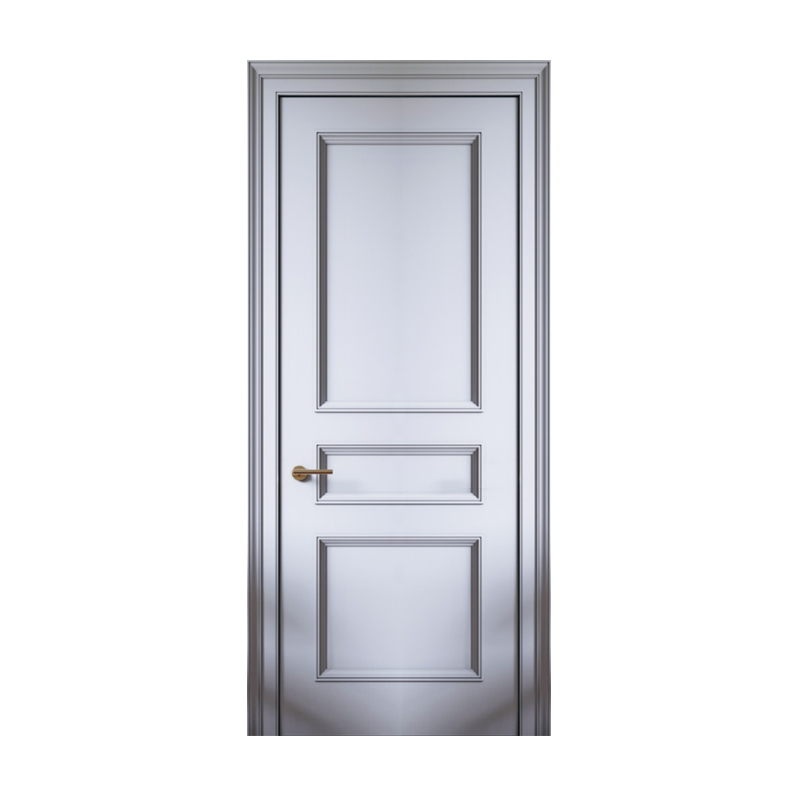
A door that knows exactly what it is. The D8645 speaks the language of European classical interior architecture — three raised panels arranged in the canonical tall-wide-wide proportion, each panel framed by a double-stepped moulding profile that catches light across two distinct relief planes, the whole composition set within a matching architrave frame that carries the same moulding vocabulary from door to wall. The finish is a cool, sophisticated light grey — neither stark white nor warm ivory, but the restrained grey-white that reads as deliberate and current in the context of contemporary classical interiors. The antique brass lever handle introduces the only warm metallic accent, its aged finish providing a considered counterpoint to the cool grey ground.
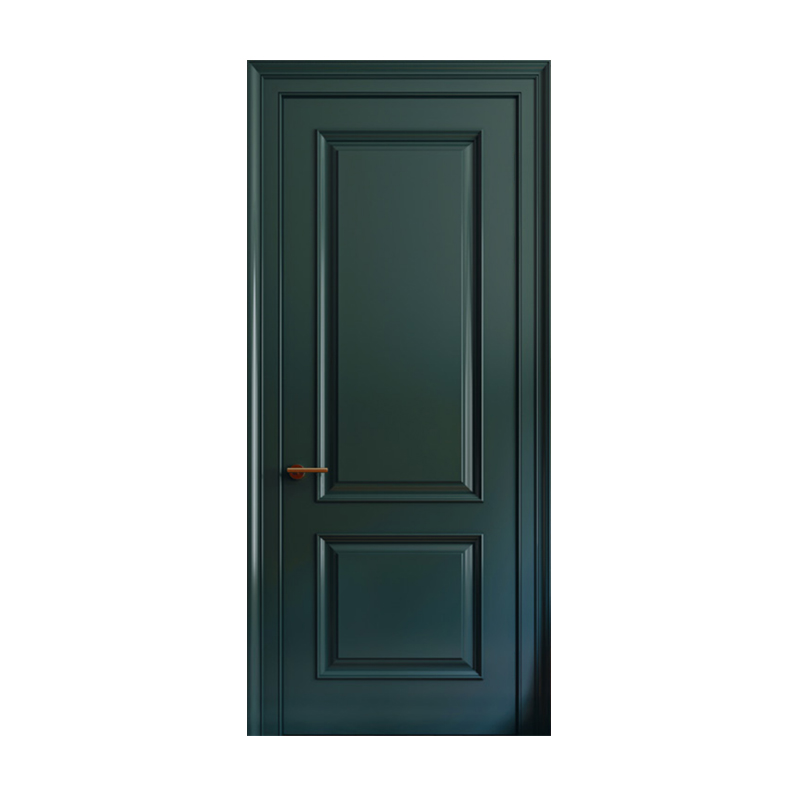
There is a moment in interior design when a room stops being decorated and starts being intentional — and it often begins with the door. The D8649 makes that case with complete confidence. Its deep forest green finish — the specific green of lacquered English estate joinery, of Parisian apartment doors glimpsed from a courtyard, of rooms that feel genuinely private — transforms the two-panel classical form from a background element into an active design statement. The double-step moulding profile here operates without any gold accent line; the finish's own depth is sufficient, the shadow between moulding levels reading as a dark, crisp line that defines the geometry entirely through relief and recession. The antique bronze lever handle — darker and more reddish-toned than the brushed brass of the D8646 and D8648 — was chosen to hold its own against the deep green ground rather than float above it.
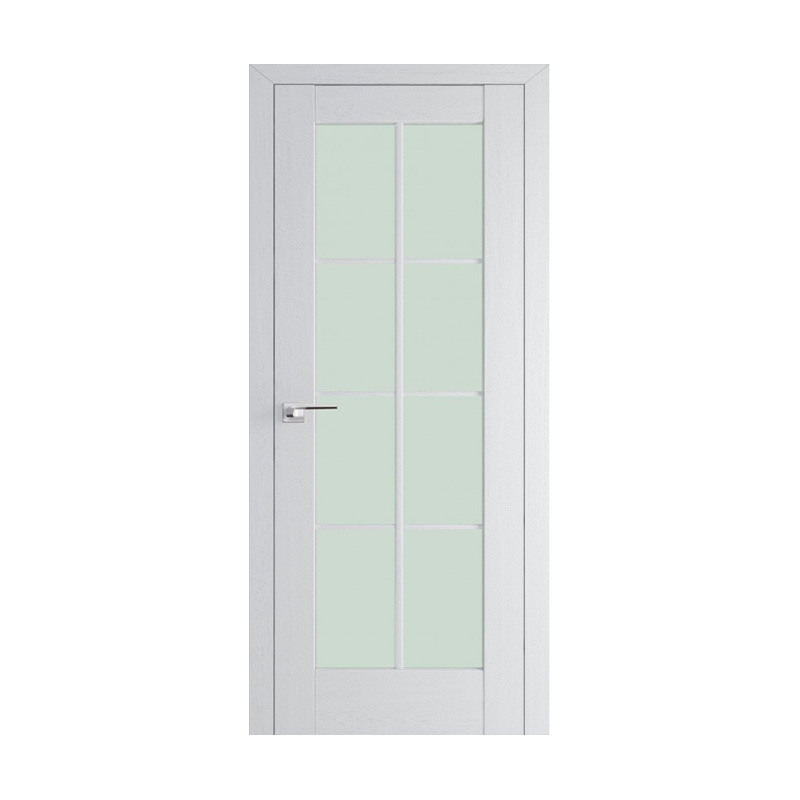
The D8700 sits precisely between the D8704's nine-pane black grid and the D8705's single undivided glass field — and in doing so, stakes out its own clearly defined position. Like the D8704 it uses a glazing bar grid to structure the glass area; like the D8705 it is white, minimal, and committed to maximising the glazed proportion of the door face. The distinction is in the grid geometry: where the D8704's 3×3 nine-pane square grid reads as a graphic composition — almost a piece of wall art — the D8700's 2×4 eight-pane arrangement (two columns, four rows of taller rectangular panes) reads as a window: specifically, as the tall, narrow, vertically emphasised sash window of Georgian and Federal architecture, or the full-height French casement of Haussmann Paris. The panes are tall rather than square, the vertical emphasis of the grid reinforcing the door's own height rather than working against it. Critically, the glazed grid here extends the full height of the door leaf — from top rail to bottom rail — with no solid lower panel; the D8700 is fully glazed, making it the most light-permeable model in the SHUIDAO glazed door range. The brushed chrome bar handle — a horizontal tubular bar rather than the square-rose lever of the D8704/D8705 — is a deliberate hardware choice that reinforces the door's connection to French door and casement window conventions.
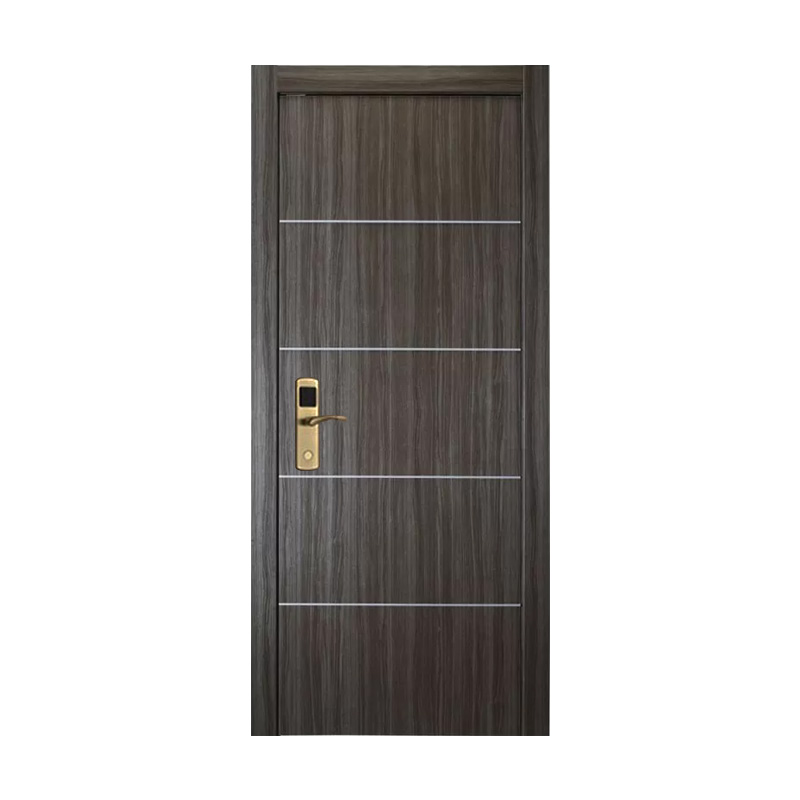
The D8666 introduces a material detail that none of the other smart lock door models in the SHUIDAO range employ: inlaid metal strip inlays running the full horizontal width of the door face. Four parallel silver / brushed aluminium strips are let into the dark grey-brown woodgrain surface at evenly distributed intervals, creating a precise horizontal rhythm across the full door width. Where the D8658 achieved a similar horizontal banding effect through routed grooves alone, the D8666 replaces shadow with material — the metal strips catch and reflect light independently of the woodgrain ground, introducing a genuine material contrast rather than a tonal one. The overall effect is closer to high-end furniture making or contemporary architectural joinery than to standard door manufacture: the inlaid metal reads as a deliberate craft decision, the kind of detail that distinguishes a specified product from a standard supply item. The dark grey-brown woodgrain — cooler and more silvered than the walnut tones of the D8658 and D8660, with a fine straight grain that runs vertically — provides the correct dark ground for the metal strips to register clearly without competing.
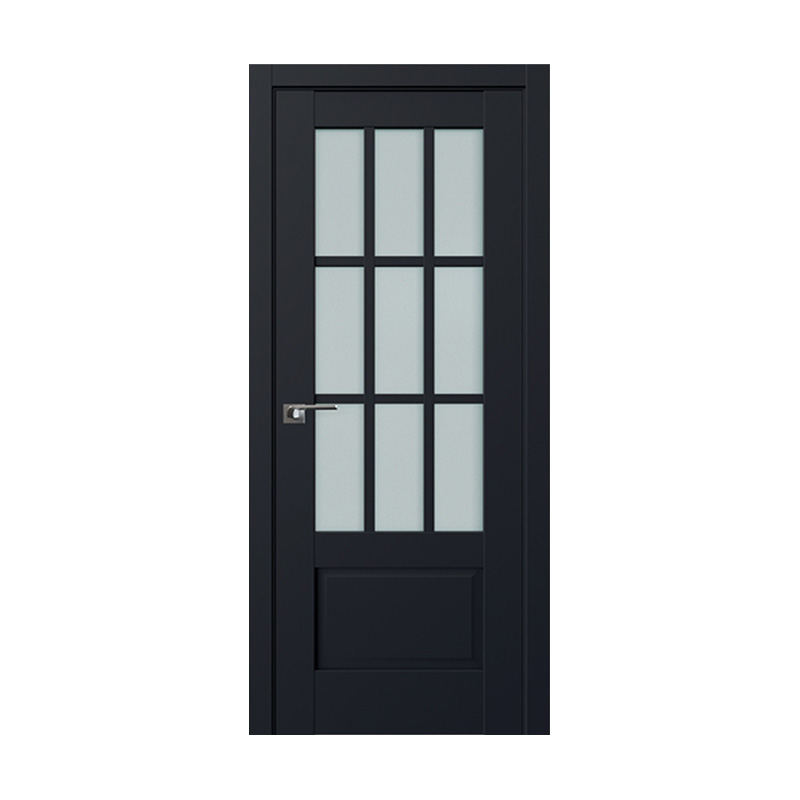
The D8704 introduces glass into the SHUIDAO interior door range for the first time — and it does so through one of the most enduring and versatile glazed door formats in modern interior design: the grid-lite. Nine panes of frosted glass, arranged in a 3×3 grid and separated by slim black glazing bars, occupy the upper two-thirds of the door face; a single solid raised panel at the lower third closes the door below handle height. The format has roots in Georgian sash windows and Victorian conservatory joinery, was revived and transformed by the Arts and Crafts movement, became a defining element of French café and brasserie interiors, and has arrived in the 21st century as a staple of contemporary industrial-lux, Japandi, and dark-luxury residential and hospitality design. In matte black — door face, frame, and glazing bars all in the same deep non-reflective finish — the nine-pane grid reads as a graphic composition rather than a window reference: nine frosted glass rectangles set in a black grid, the soft diffused light passing through the glass panels creating a luminous, backlit quality that changes character entirely depending on the light conditions on either side of the door. The gunmetal square-rose lever handle is minimal, architectural, and correctly scaled.
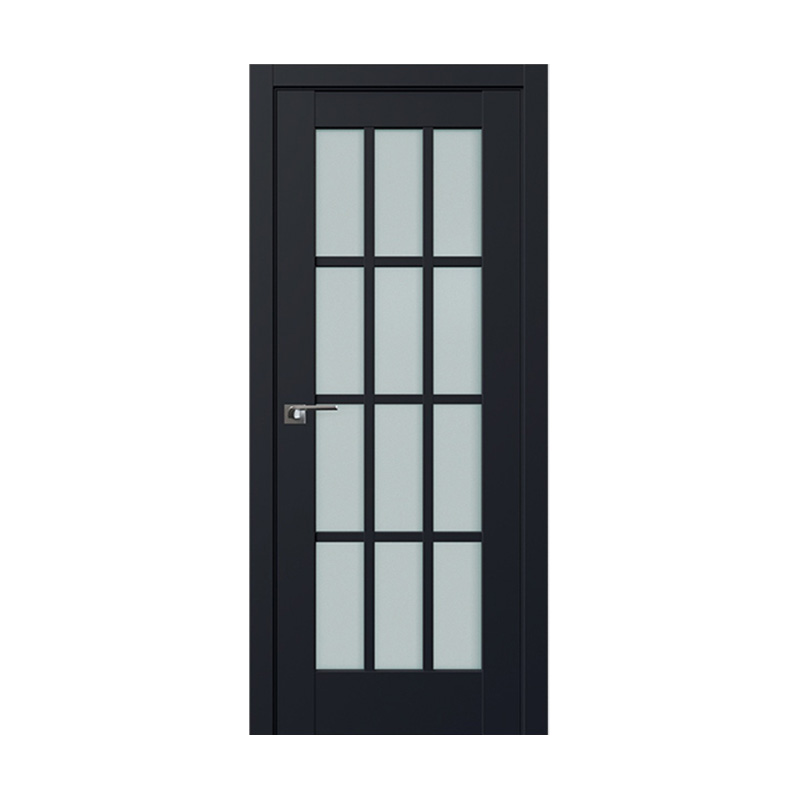
The D8702 is the D8700's dark counterpart and the D8704's fully glazed sibling — and it resolves a specific question that the existing glazed door range poses: what happens when you take the D8700's fully glazed 2-column format, keep the matte black finish of the D8704, and add one additional row of panes? The answer is the D8702: twelve panes in a 3-column × 4-row grid, full door height, no solid lower panel, all in matte black with the same gunmetal square-rose lever handle that the D8704 established as the hardware language of the black glazed door sub-range. The move from two columns to three, and from eight or nine panes to twelve, changes the grid's character meaningfully. The D8700's two-column grid reads as a tall French casement window. The D8704's 3×3 grid reads as a compact graphic composition. The D8702's 3×4 twelve-pane grid — three columns of four tall rectangular panes — reads as something more architectural: an orangery window, a Victorian conservatory facade, a full-height industrial clerestory. The grid is dense enough to be structural-looking, open enough to pass abundant diffused light, and in matte black substantial enough to anchor an entire room's design language.
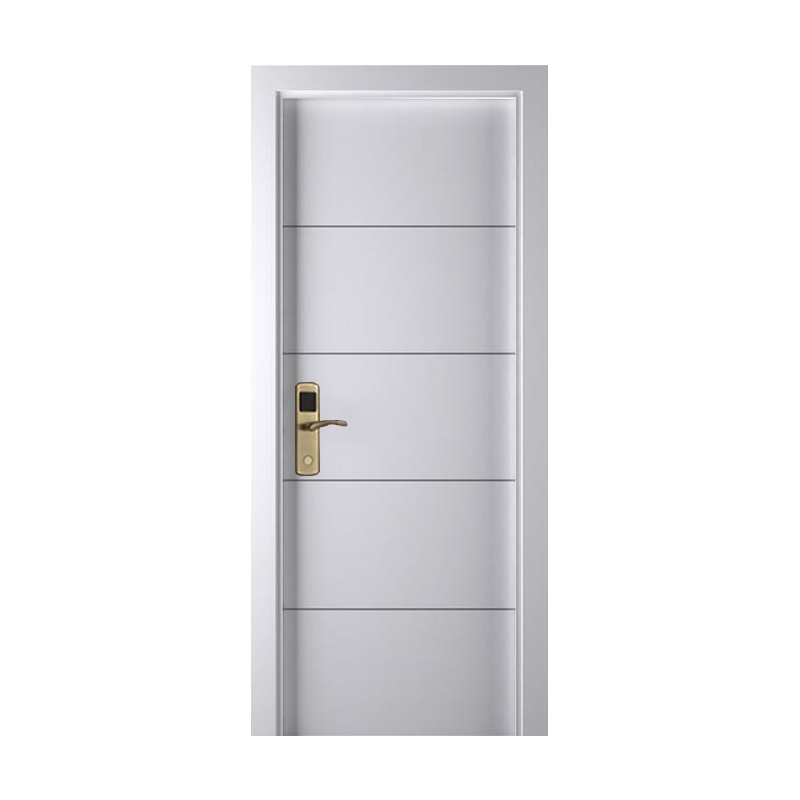
The D8664 is the white equivalent of the D8658's warm-walnut grooved-panel format — the same five-band horizontal groove composition, the same evenly distributed parallel lines dividing the door face into five equal fields, but here executed entirely in white. And white changes everything. Where the D8658's grooves read as warm and residential against the walnut ground, the D8664's grooves read as architectural and precise against the white — the shadow lines sharper, the bands more graphic, the overall effect closer to a wall panel system or a contemporary joinery cabinet face than to a timber door. The door is also notably wider in proportion than most of the other D86 models — a broader leaf that gives the five-band composition more horizontal breathing room and makes the groove rhythm feel more measured and considered. The antique brass electronic lever lock is the one element that prevents the white door from reading as clinical: its warm, aged gold tone is the exact counterpoint the all-white composition needs, the single chromatic note that confirms this is a luxury product rather than a builder's standard.
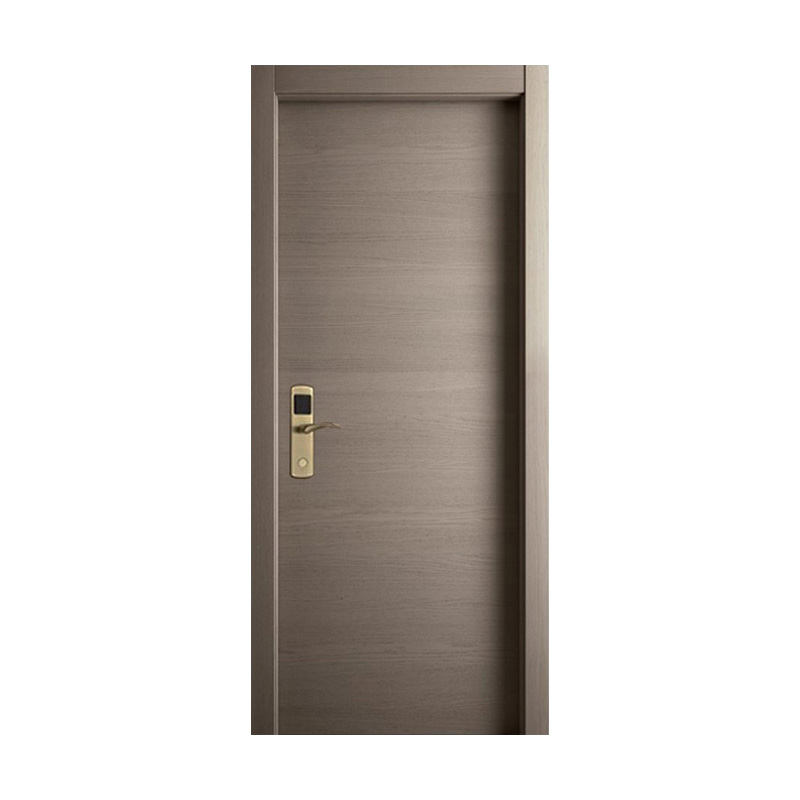
Within the SHUIDAO smart lock flush door range, each model has staked out its own colour territory — the D8657's near-black wenge, the D8658's warm mid-walnut, the D8659's amber cherry, the D8660's greige grid composition. The D8655 occupies the coolest, most contemporary position of the group: a fine horizontal woodgrain in a desaturated grey-taupe — the specific tone that sits at the intersection of greyed oak, warm grey, and the muted linen colours that have defined high-end Scandinavian and Japanese hospitality interiors for the past decade. The grain here runs horizontally rather than vertically, a distinction that subtly widens the perceived door face and gives the surface a more architectural, less timber-yard quality. The satin brass electronic lever lock — warmer and more matte than the bright champagne gold of the D8657/D8658, yet lighter and less aged than the antique bronze of the D8659 — is precisely calibrated to the grey-taupe ground: enough warmth to prevent the door from reading as cold, not so much as to introduce the residential sweetness that a darker bronze would carry.
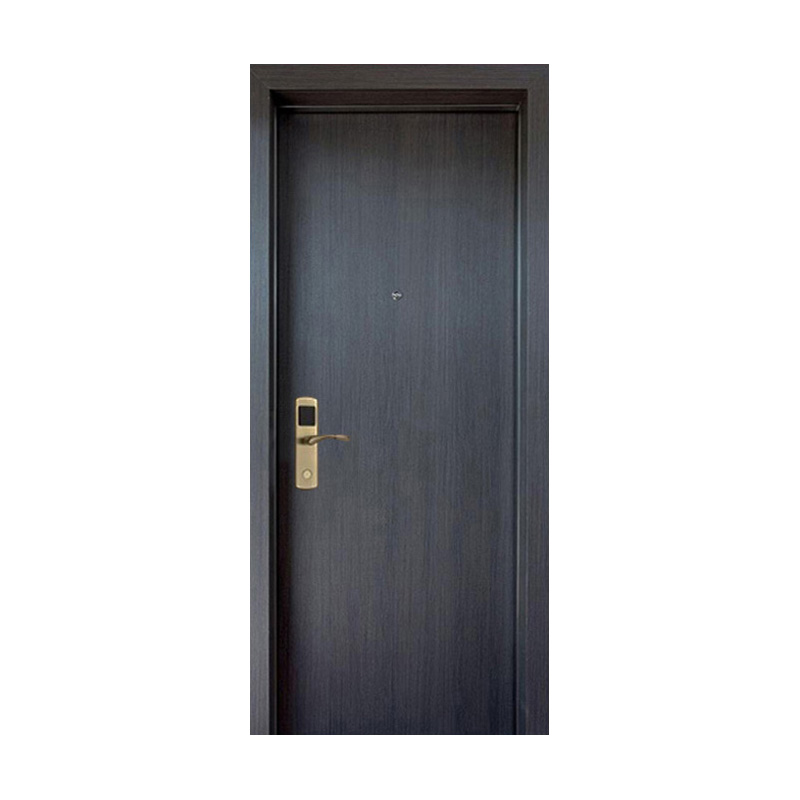
The D8657 is the series' first complete departure from decorative panel moulding — and it is a purposeful one. Where the D8645 through D8650 speak in the vocabulary of classical relief, the D8657 speaks in the language of contemporary hospitality and residential security: a completely flat, flush-faced door leaf, surfaced in a dark wenge-tone woodgrain veneer or foil, paired with a gold-tone electronic smart lock system that is the door's sole surface feature. The effect is clean, functional, and immediately recognisable as the standard visual language of mid-to-high-end hotel guest room and serviced apartment entry doors globally — a format where the door's job is not to decorate but to perform, and where the lock system itself carries all the design content. The fine vertical woodgrain texture runs full-height across the flush face, providing enough surface movement to prevent the door from reading as featureless while maintaining the strict planarity that flush-panel construction requires.
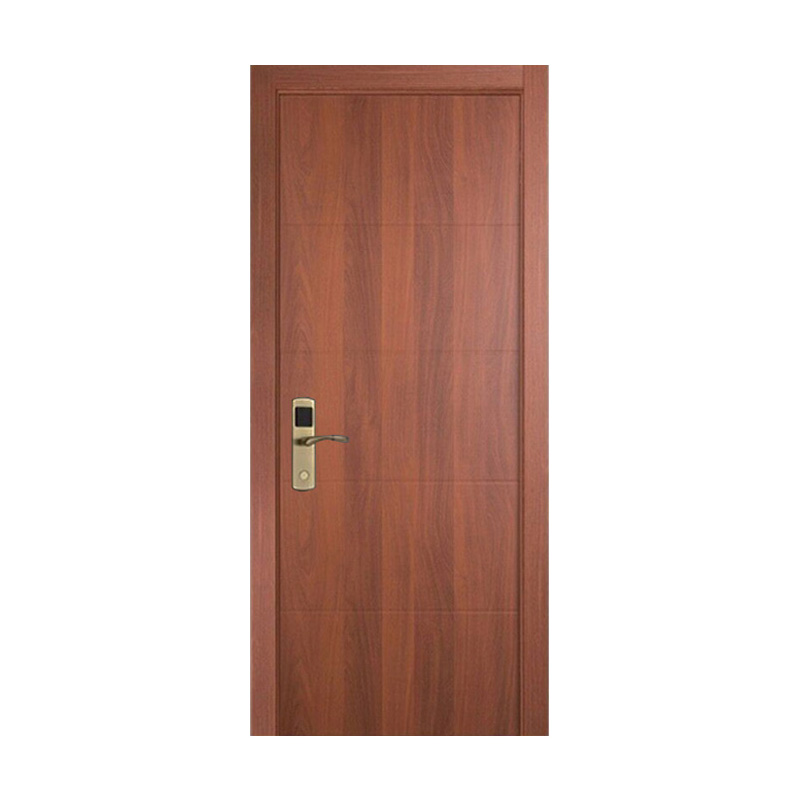
The D8659 completes the smart lock flush-door trio alongside the D8657 and D8658 — and it does so by shifting both the colour temperature and the surface approach once more. Where the D8657 is dark and austere, and the D8658 adds horizontal groove articulation in a warm mid-walnut, the D8659 returns to a fully flush, zero-groove face but wraps it in the warmest, most residential tone of the three: a rich cherry-walnut woodgrain that reads as genuinely warm, even amber-toned under certain light conditions. The surface is completely flat and uninterrupted — no grooves, no inlays, no relief — but a single very fine hairline horizontal seam is visible at approximately mid-door height, suggesting a two-piece construction join or a deliberate design line that divides the flush face into upper and lower halves with the lightest possible touch. The antique bronze lock escutcheon — darker and more aged in tone than the bright gold of the D8657 and D8658 — is the right hardware choice for this warmer, more residential colour register.
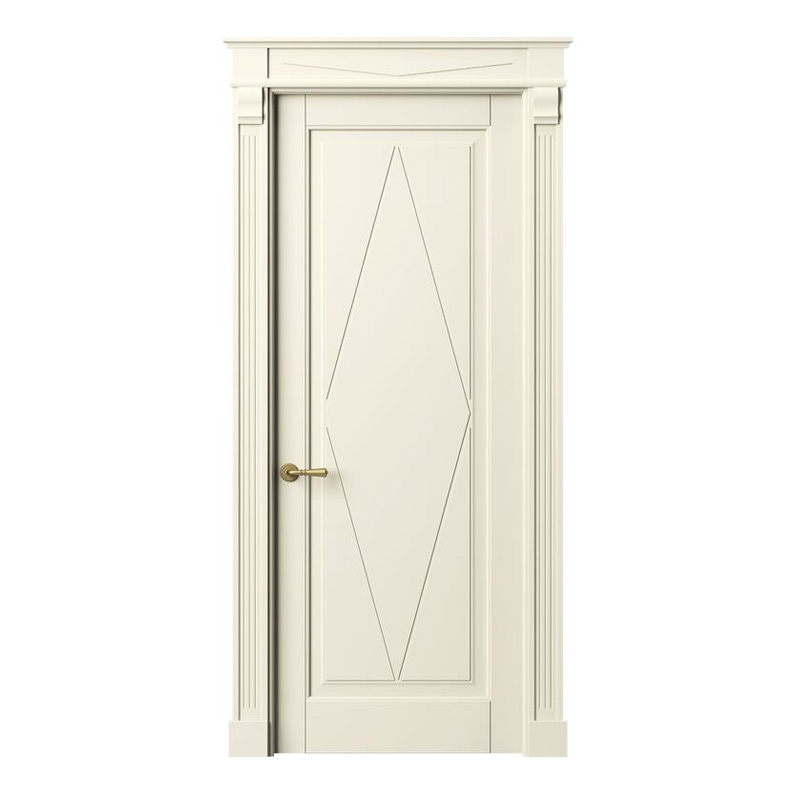
The D8669 placed a repeating diamond lozenge motif within three stacked panels. The D8670 makes a bolder, more singular move: it abandons the multi-panel format entirely in favour of a single full-height panel field, and within that field places one large elongated diamond lozenge that spans nearly the full height and width of the panel — a single graphic shape, drawn in fine routed or applied moulding lines, that turns the entire door face into one unified geometric composition. The diamond here is not the compact, near-square lozenge of the D8669's repeating motif — it is a tall, vertically elongated diamond whose upper and lower points approach the top and bottom panel borders, and whose left and right points reach close to the stile edges; from each corner of the diamond, diagonal lines extend to the four corners of the surrounding rectangular panel border, completing the X-within-rectangle geometry that is the door's entire decorative programme. In warm ivory — a tone that reads as the finest quality aged plaster, or the linen-white of freshly prepared gesso — the routed diamond lines register as the finest possible shadow lines against the light ground, the geometry perceptible but never emphatic. The antique brass lever handle is, again, the perfect single warm accent.
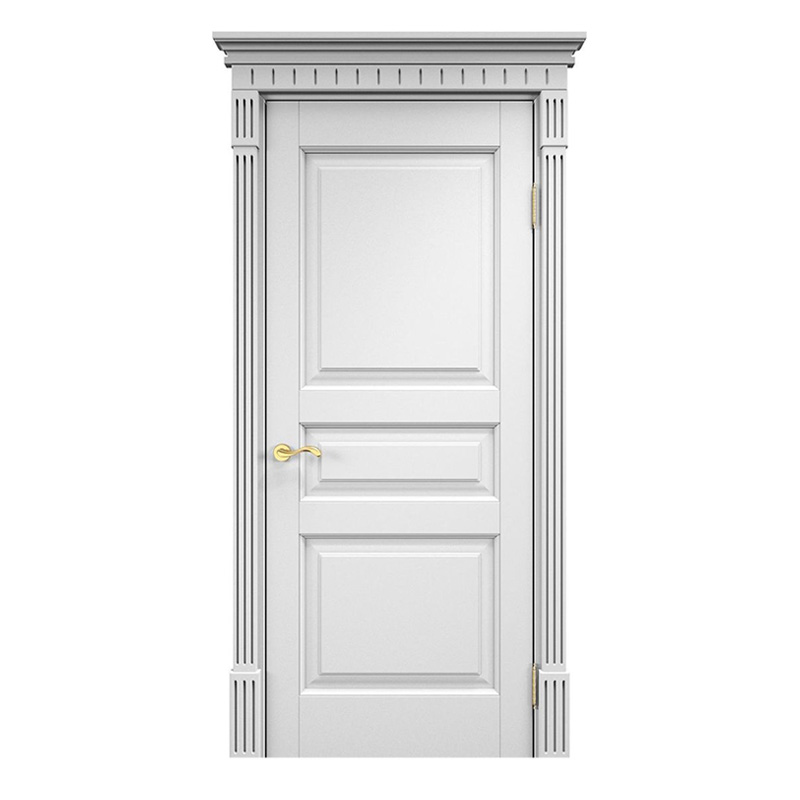
If the D8667 is the warm-stone-grey interpretation of classical architectural joinery — painterly, soft, Southern European in register — the D8668 is its white counterpart, and white here does not mean simple. It means precise. Every element of the D8667's architectural vocabulary is present in the D8668 and then elaborated further: the cornice entablature gains a dentil frieze — a row of closely spaced rectangular tooth-like projections running the full width of the head, one of the most recognisable and formally demanding details in the classical orders; the flat pilaster strips of the D8667 become fully articulated fluted pilasters — columns with vertical carved channels running their full height, the hallmark of Doric, Ionic, and Corinthian classical architecture translated into joinery; and the door leaf itself expands from two panels to three, the three equal-height panels recalling the D8645 and D8647 but here in a white painted finish where the moulding relief reads with crystalline sharpness. The polished brass lever handle is the one warm accent in an otherwise entirely white composition — and against this white, polished brass achieves a luminosity and formality that no other hardware finish can match.
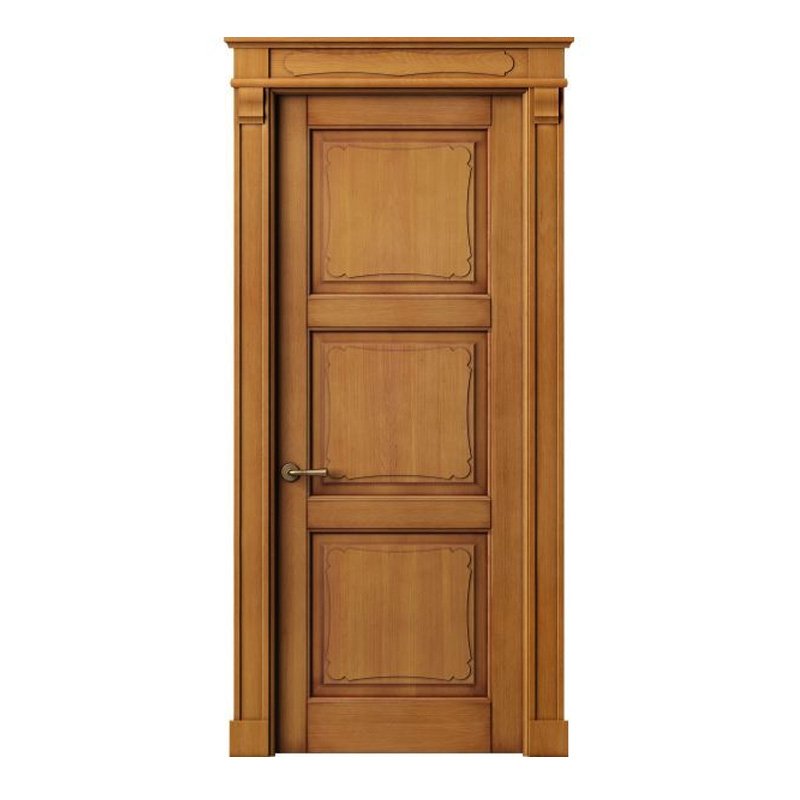
The D8672 is a departure from every other door in the SHUIDAO D86 range — not in degree but in kind. Where the D8645 through D8665 are painted or foil-finished doors that reference classical or contemporary traditions through their surface geometry, the D8672 is something categorically different: a full solid timber door with a complete architectural surround, carved decorative moulding, pilaster columns, a broken-pediment-style entablature head, and plinth blocks at the base — a door assembly that belongs to the language of 18th-century European palace interiors, grand colonial villas, and luxury residential developments where joinery is understood as architecture. The warm honey-amber tone of the timber — a natural teak, oak, or hardwood species with an open, straight grain and a clear or lightly tinted finish — is the finish of real wood that has been worked, not imitated. The carved cartouche moulding within each panel, the bolection moulding rails and stiles, the fluted pilaster columns flanking the door leaf, and the decorative entablature head above all speak a unified classical grammar that no paint finish or foil surface can replicate.
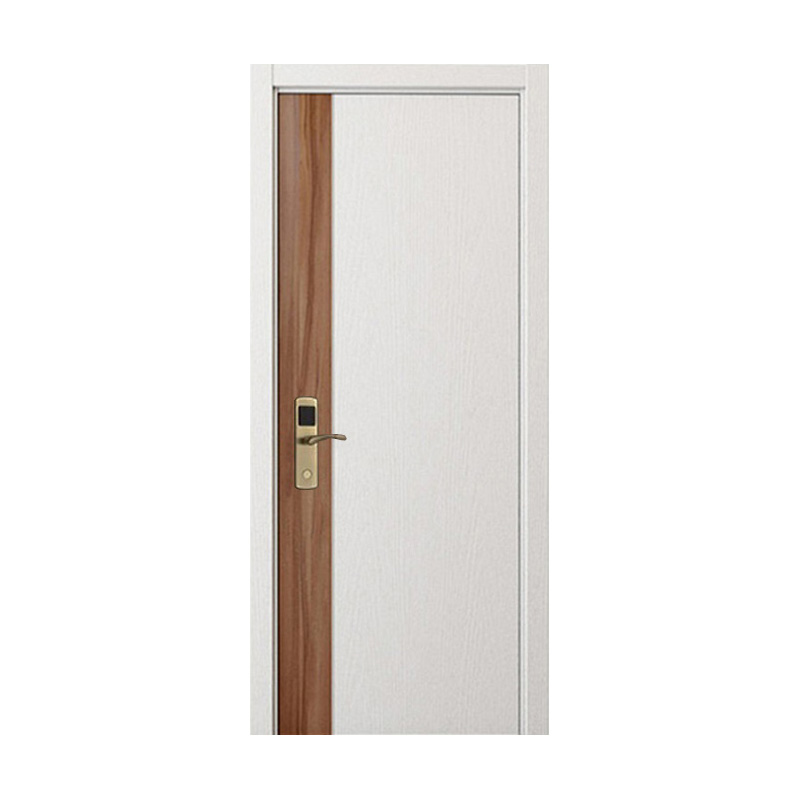
Every other door in the SHUIDAO smart lock range is a single-material, single-finish proposition — one woodgrain tone, one surface treatment, one colour story. The D8662 breaks that rule with the simplest possible two-material move: a wide white woodgrain field occupying roughly four-fifths of the door face, and a single vertical walnut accent strip inlaid at the lock-side stile, running the full door height. The result is a door that reads as both light and grounded simultaneously — the white field opens the door face up, gives it freshness and air; the walnut strip introduces warmth, weight, and a vertical accent line that prevents the white ground from reading as blank. It is the same compositional logic as a white wall with a single timber feature panel, or a white bathroom with a walnut vanity — a material pairing so reliably effective in contemporary residential and hospitality interiors that it has become a design language of its own. The satin gold lock escutcheon sits precisely at the junction of the walnut strip and the white field, its warm gold tone belonging equally to both materials.