
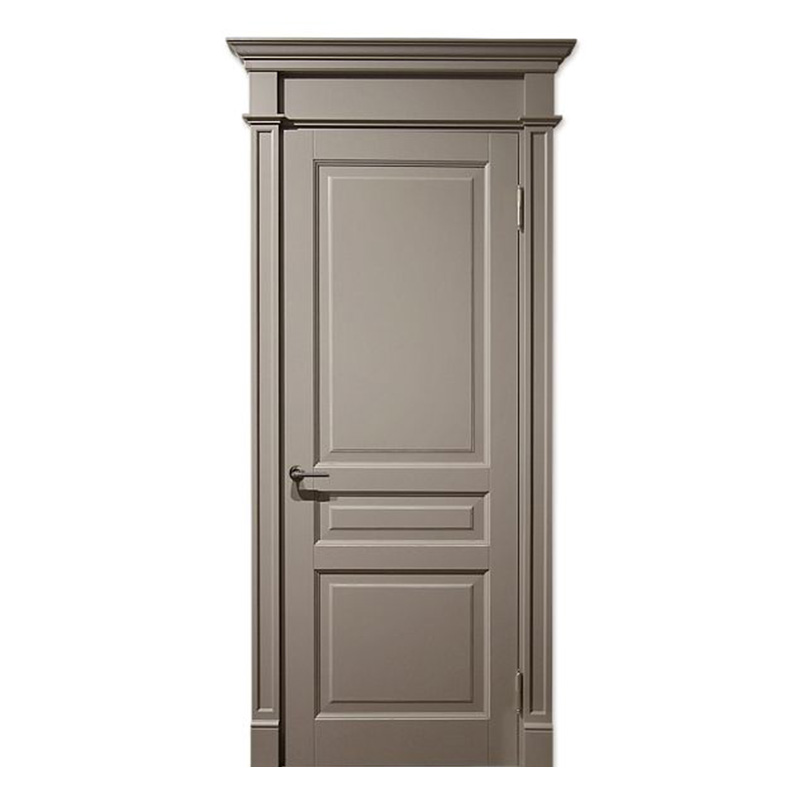
The D8667 sits between the painted classical panel doors of the D8645–D8650 series and the full solid-timber grandeur of the D8672 — it shares with both its architectural ambition, but it arrives in a finish and surround format that places it firmly in the tradition of the great painted classical interiors: Haussmann Paris, Georgian London, Federal New York, and the grand villa interiors of northern Italy where paint was always the preferred vehicle for classical architectural detailing because it unified door, surround, wall, and cornice into a single seamless architectural composition. The finish is a warm stone-grey — the exact tone of aged limestone, of Parisian plaster, of the grey that reads simultaneously as elegant restraint and genuine luxury — applied monochromatically across the door leaf, the full architectural cornice surround, and the pilaster-base plinth blocks. The surround here is more elaborate than the D8672's pilaster format: a full projecting cornice entablature with a bold stepped fascia and cyma recta profile at the top, flanked by pilaster capitals that transition into the door frame reveals. The two-panel door leaf — one very tall upper panel, one shorter lower panel — sits within this surround as the centrepiece of a complete architectural composition.
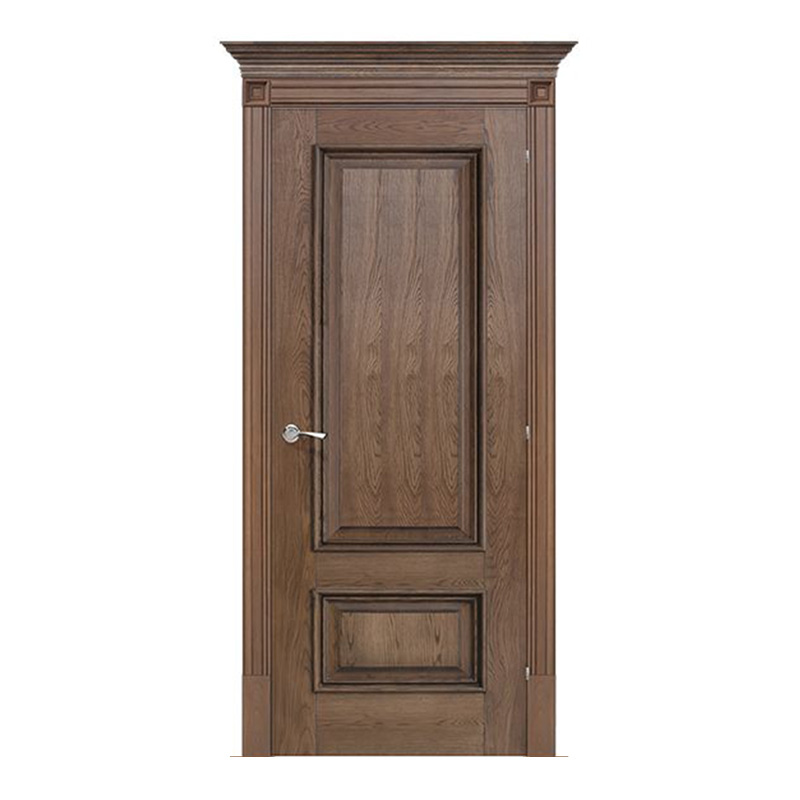
The D8671 returns to the solid timber tradition of the D8672 but arrives at it from a different compositional angle. Where the D8672's three equal panels and carved cartouche moulding speak the language of French 18th-century boiserie, the D8671's two-panel format — one very tall dominant upper panel, one shorter anchoring lower panel — belongs to a more restrained classical tradition: English Georgian, American Federal, or the Biedermeier-influenced Central European villa interior, where timber grain was considered decoration enough and the joinery's role was to display the wood rather than to elaborate upon it. And the timber here earns that confidence. The grain visible in the upper panel is genuinely spectacular — a wide, open-figured oak or elm with broad cathedral arching and flamed figuring that shifts across the panel face like a landscape seen from altitude. The darker stain — a warm tobacco-brown that deepens the grain contrast without obscuring the figuring — gives the door a richness and depth that paint can never replicate. The full cornice surround, with its bold projecting entablature, keystoned or panelled frieze, and pilaster-format side reveals, frames the figured timber door leaf as the centrepiece of a complete architectural statement.
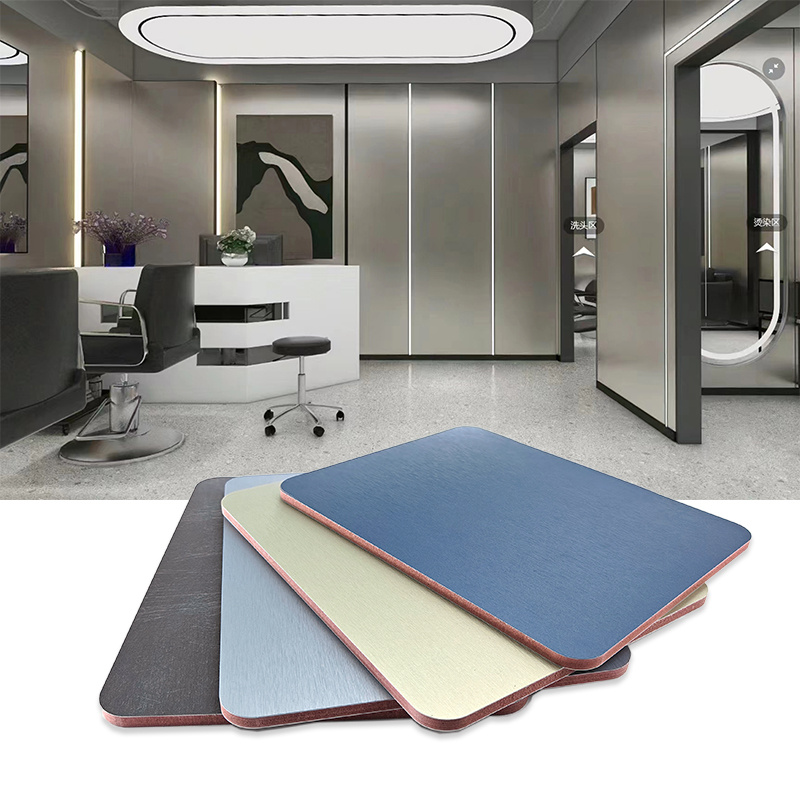
Not every wall needs a profile. Some of the most resolved contemporary interiors — the kind found in premium hair salons, hotel lobbies, corporate offices, and high-end retail environments — are built on perfectly flat, large-format wall panels whose surface quality is expressed entirely through material finish rather than three-dimensional geometry. The SD-AGWP031 is that panel. A completely flat, smooth-face wall cladding board with a fine brushed / satin linear texture, it installs edge-to-edge in large-format runs to create seamless, monolithic wall surfaces where the material itself — its colour, its texture, its light response — does all the design work. The installation scene shows exactly this application: a full-height commercial interior wall in brushed grey-silver, divided by fine vertical LED or metal strip lines at panel junctions, producing a wall surface of exceptional contemporary sophistication with zero decorative elaboration.
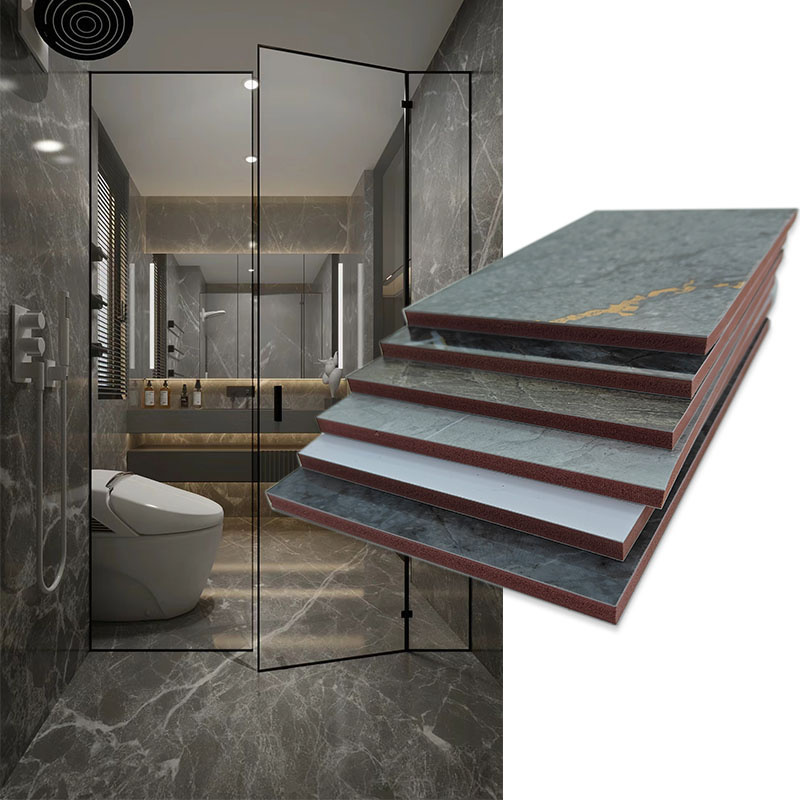
The bathroom in this installation scene makes a single, complete material statement: every surface — walls, shower surround, floor — clad in the same dark grey marble-effect flat panel, the continuity of the stone pattern across floor, wall, and shower enclosure creating the seamless, monolithic quality that is only otherwise achievable with genuinely large-format natural stone slabs. The SD-AGWP031 delivers this effect in a composite panel format that natural stone cannot: lightweight, installation-ready, pre-finished, and — critically — confirmed here as suitable for wet area and bathroom applications where genuine marble would require sealing, maintenance, and specialist installation. The dark grey marble with warm gold veining shown in the sample stack is the luxury residential bathroom specification of the current decade; the SD-AGWP031 makes it achievable without the cost, weight, fragility, and maintenance obligations of natural stone.
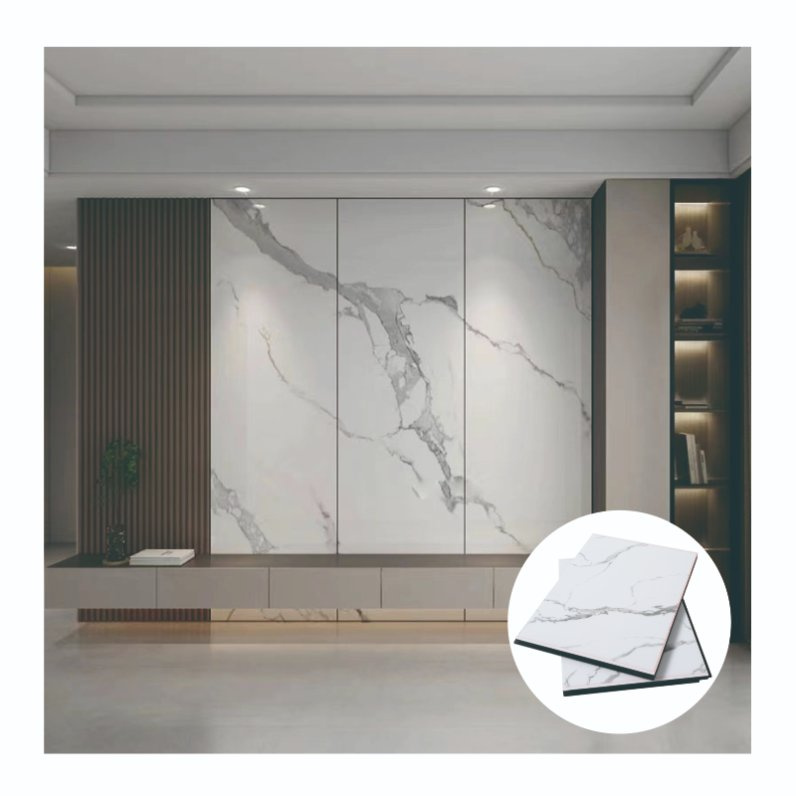
The defining quality of a natural stone feature wall — the one that separates it from all tile and smaller-format alternatives — is the continuous vein: a single geological line that runs uninterrupted across the full wall width, ignoring the joins between slabs as if they were not there. The SD-AGWP033 replicates this quality in a large-format composite panel format: three panels installed edge-to-edge in the installation scene carry a Calacatta marble pattern whose grey and gold veins sweep continuously from left panel to right panel, the diagonal vein lines crossing the join lines without interruption. The result is the visual effect of a single enormous stone slab covering the full wall — the domestic equivalent of the book-matched marble walls found in five-star hotel lobbies and luxury flagship retail. The gloss surface amplifies the effect, the ceiling downlights reflecting off the white marble ground and producing the luminous, light-filling quality that makes Calacatta marble the perennial default of luxury interior design.
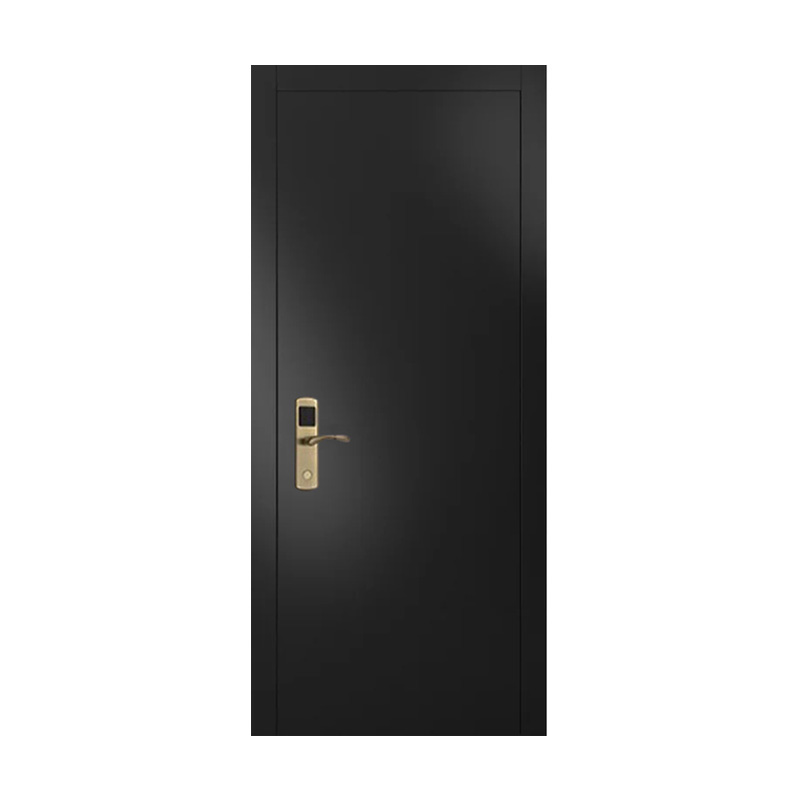
The D8665 is the most reductive statement in the entire SHUIDAO door range — classical or contemporary, grooved or gridded, woodgrain or painted. It offers nothing but a perfectly flat matte black surface, a clean rectangular frame, and a single antique brass lock escutcheon positioned at standard handle height on the left stile. No grain. No grooves. No inlay strips. No panel geometry. No surface texture of any kind visible at normal viewing distance. The door is, in the strictest sense, an object defined entirely by its colour and its flatness — and that is precisely the point. Matte black as a door finish has migrated decisively from industrial loft aesthetics into mainstream luxury hospitality and residential design over the past several years, and the D8665 is its purest expression: a door that asserts itself through tonal dominance rather than surface elaboration, that frames a room opening as a graphic void, and that makes every other material in the corridor or room — stone, timber, metal, textile — read more vividly by contrast. The antique brass lock on a matte black ground is one of the most reliably effective material pairings in contemporary interior design, the warm aged gold reading with maximum luminosity against the non-reflective dark field.
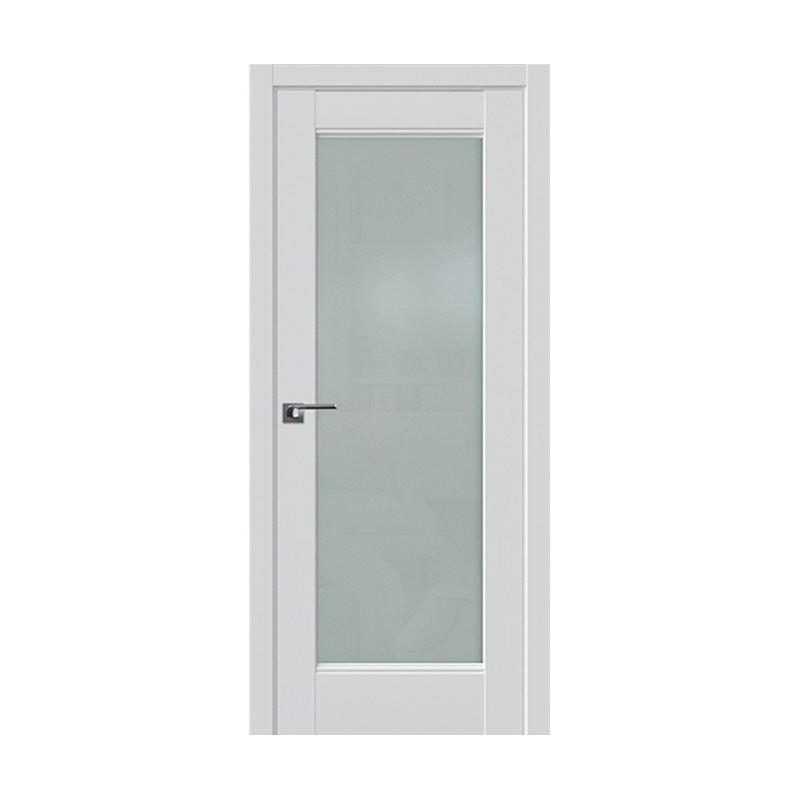
Where the D8704 uses the nine-pane grid to structure and articulate its glazed area, the D8705 makes the opposite decision with complete conviction: one single uninterrupted pane of frosted glass, spanning nearly the full height of the door from just below the top rail to just above the bottom rail, with no glazing bars, no grid, no subdivisions of any kind. The glass is the door. The white frame — top rail, bottom rail, lock stile, hinge stile — is reduced to the minimum structural necessity, present only to hold the glass and carry the hardware. The result is a door that feels closer to a frameless glass partition than to a traditional timber door, yet retains the warmth and material presence of a white-painted solid construction at its perimeter. The frosted glass diffuses light across its full height — a column of soft, even luminosity when backlit — while the matte white frame keeps the composition pure, calm, and architecturally neutral. The gunmetal square-rose lever handle, carried over from the D8704 in the same dark metal and square backplate format, is the one deliberate material contrast: small, precise, and correctly proportioned against the large glass field.
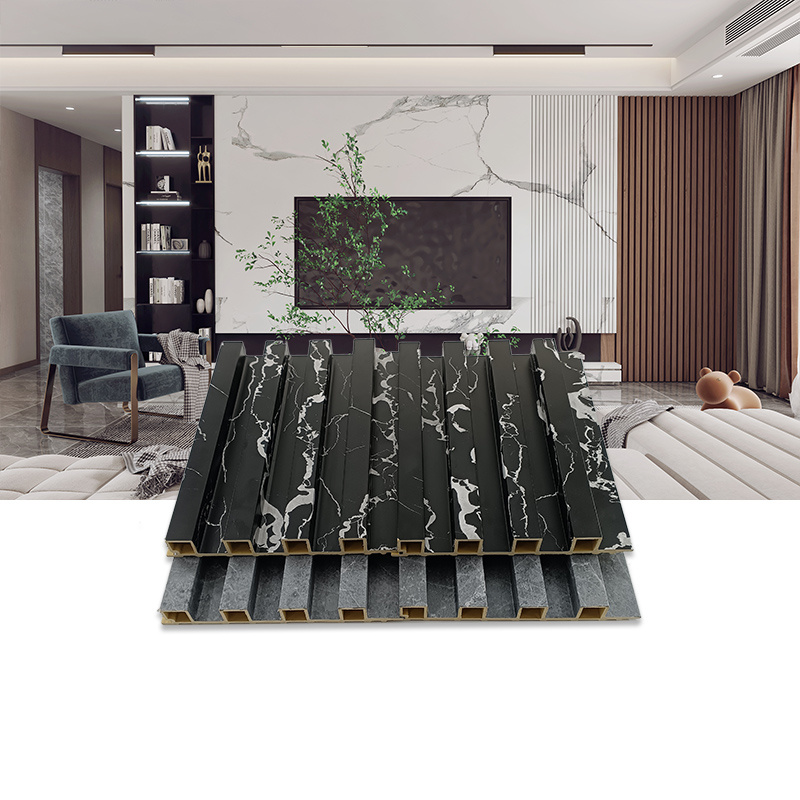
The SD-AGWP025 is built on a single, confident idea: take the architectural language of the slatted timber wall — one of the defining interior design movements of the past decade — and deliver it in a material that stone-finishes it into the luxury tier. Multiple square-profile batten ribs, tightly and evenly pitched across the panel width, create a dense vertical grid that reads as contemporary architectural cladding at scale. The WPC hollow-core extrusion gives each batten structural rigidity with minimal weight. But it is the surface finish programme that positions the SD-AGWP025 as a premium product: three confirmed stone and marble finishes — black Marquina with white lightning veining, Calacatta white with grey veining, and dark grey concrete-stone — each applied continuously across batten tops, sides, and channel floors, so the stone pattern runs uninterrupted across the full three-dimensional surface of every rib.
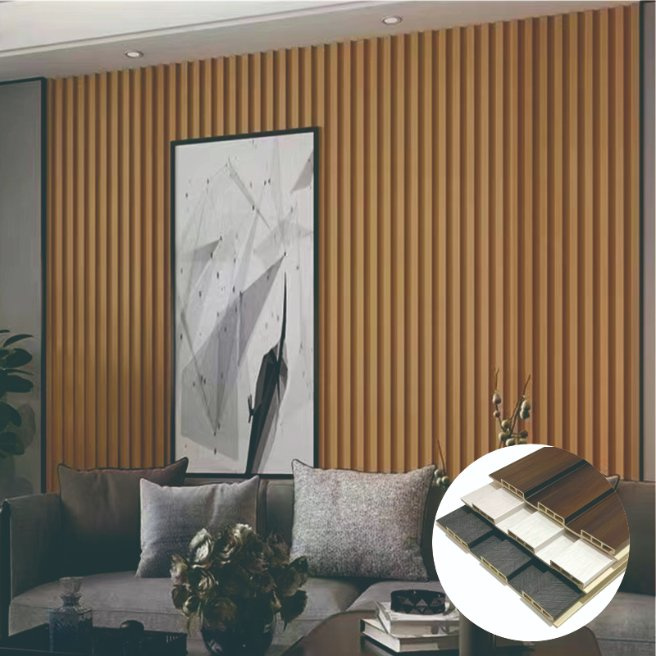
Where the SD-AGWP028 makes its statement through four wide, architecturally spaced square hollow battens, the SD-AGWP029 takes the opposite compositional position: more battens, narrower pitch, softer profile. The result is a wall surface whose installed character reads less as a grid of individual architectural elements and more as a unified directional texture — the kind of surface that covers an entire room wall and recedes into the background as warm material atmosphere rather than asserting itself as a designed object. The full-width living room installation confirms this: floor-to-ceiling honey oak panels across the entire wall, a large artwork hung directly on the surface, and the panel itself functioning as a warm, directional backdrop rather than a feature. The rounded or slightly tapered flute profile — softer than the SD-AGWP028's hard square section — reinforces this atmospheric quality, the curved rib edges catching light more gently and casting softer shadow lines than angular profiles.
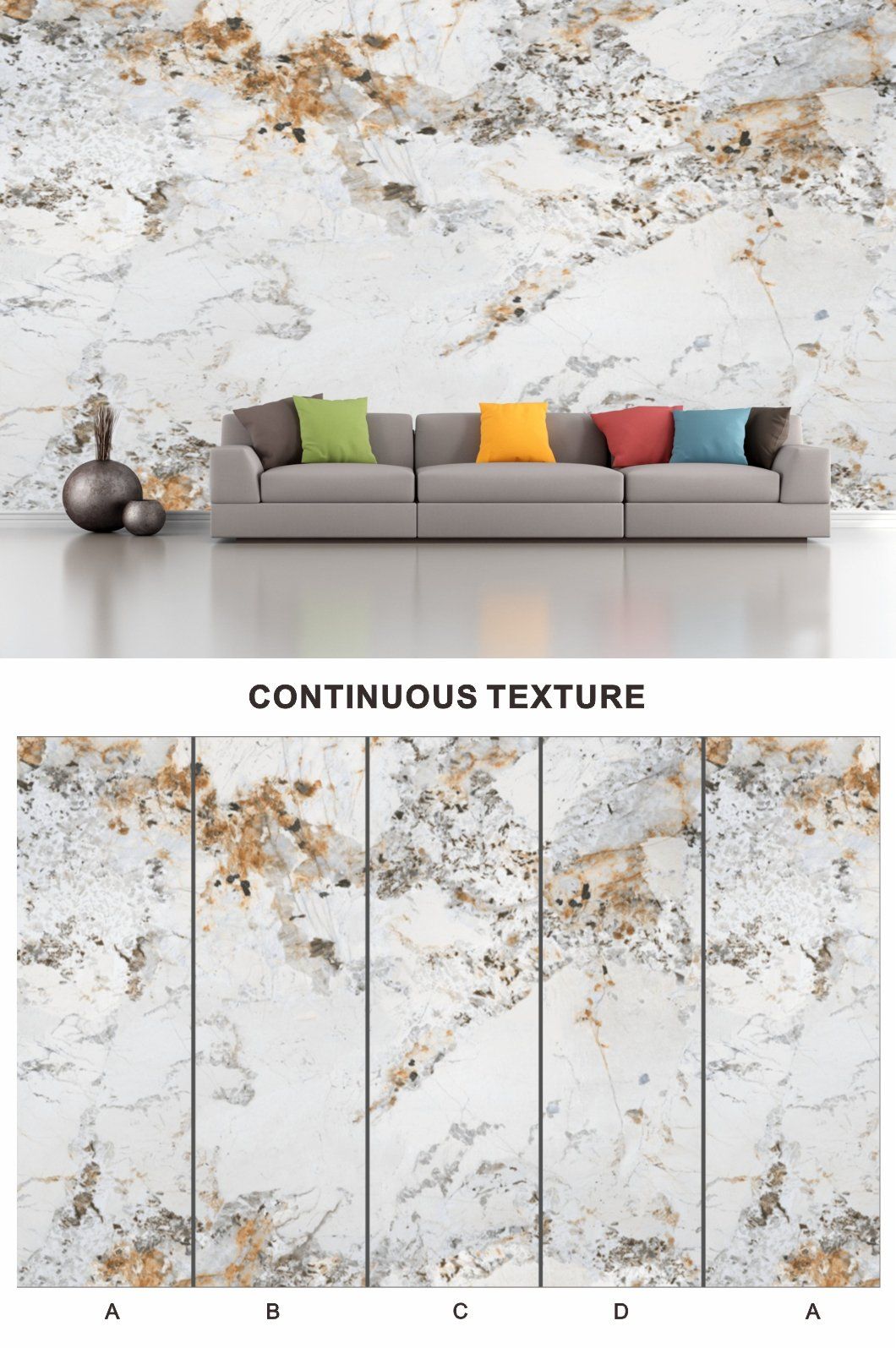
If SD-AGWP033 is the white marble that enlarges a room by erasing its walls, SD-AGWP034 is the exotic stone that makes the wall itself the destination. The pattern on this panel is not a vein — it is a geological event: amber and rust mineral formations erupting across a white crystalline ground, dark charcoal inclusions clustering at the composition's densest points, silver-grey fracture lines branching outward like frozen lightning. At full living room wall scale, installed as a continuous four-panel ABCDA sequence, the SD-AGWP034 produces a wall surface that reads as a single slab of rare Brazilian quartzite — the kind of stone that, in natural form, would require an extraordinary quarry find, a specialist stonemason, and a very large budget. The SD-AGWP034 delivers that result as a pre-engineered panel system: four panel variants, factory-registered for continuous pattern flow, installed in sequence to produce the geological panorama shown above with no visible joins and no pattern repeat breaks.
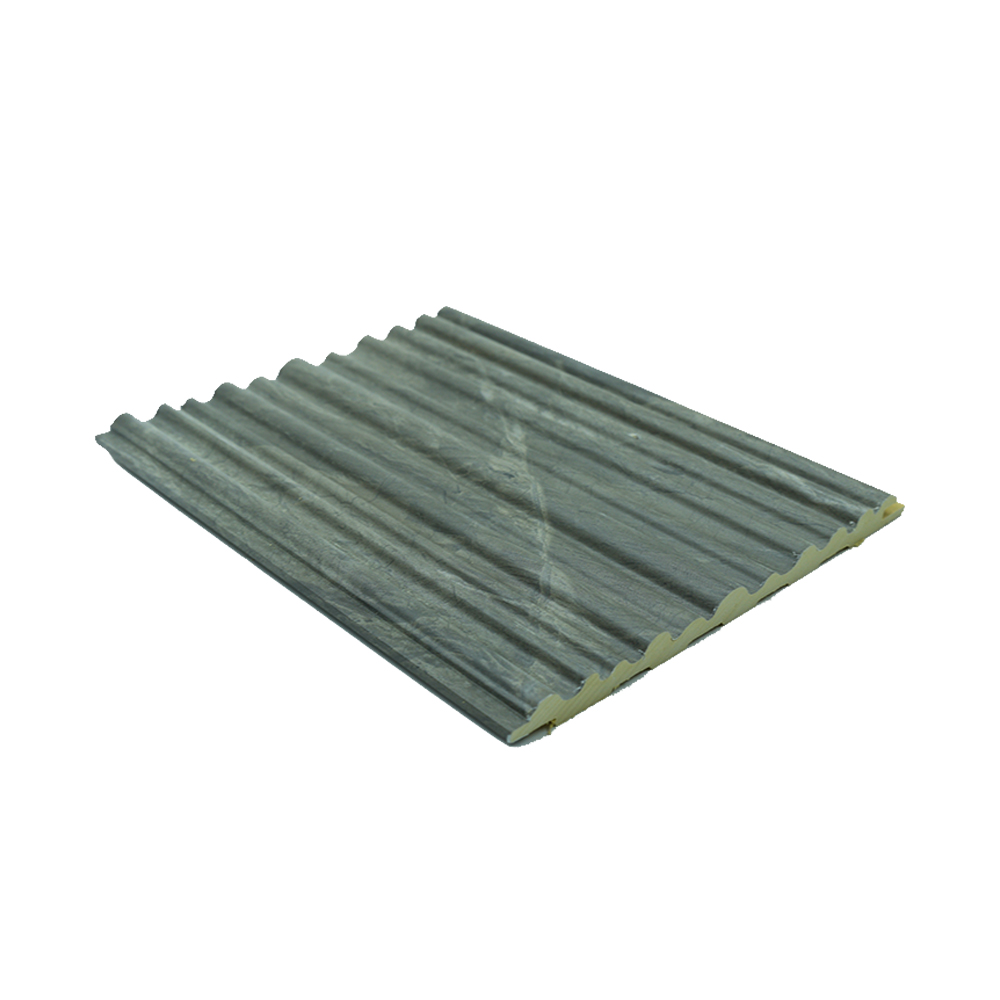
A flat wall is a missed opportunity. The SD-AGWP024 corrects that with one of the most spatially effective surface treatments in contemporary interior design: a dense, rhythmic array of parallel half-round flutes — nine to ten convex ribs running the full panel length — that transforms any plain wall surface into a composition of light, shadow, and material texture. The profile is not decorative in the traditional sense; it is architectural. The tight-pitched reeded surface catches directional light along every ridge and drops shadow into every valley between them, creating a constantly shifting surface that reads differently under morning, afternoon, and artificial light. The sage grey-green woodgrain finish places this panel firmly within the current design moment — the intersection of biophilic material warmth and the cool, botanical colour direction that has defined high-end residential and hospitality interiors globally over the past several years.
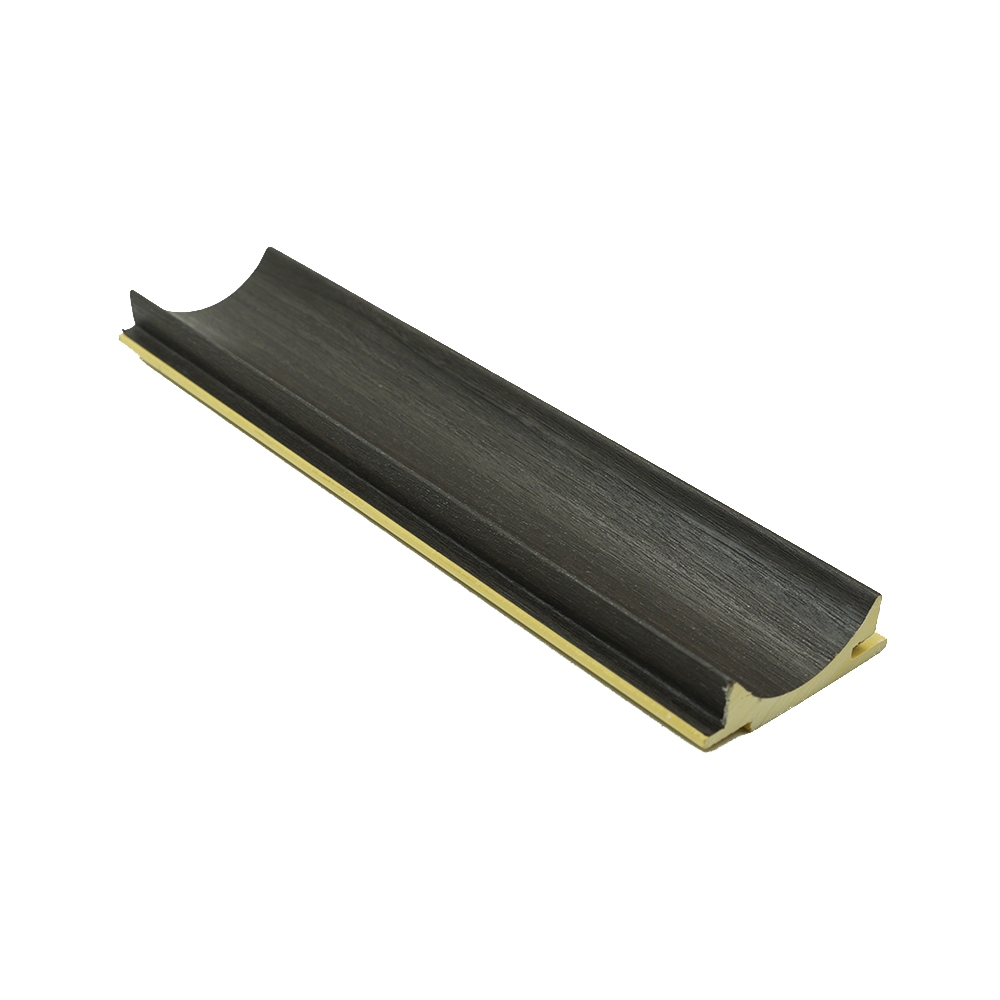
There is a moment in a well-designed interior when the wall stops being a background and becomes part of the architecture — and it is usually achieved not by paint or wallpaper alone, but by the introduction of a moulding profile that gives the flat wall surface depth, shadow, and material character. The SD-AGWP023 is that element. A concave cove-profile decorative strip in deep wenge-tone woodgrain, it is the component that transforms a plain painted wall into a panelled surface: installed horizontally as a dado or picture rail, vertically to define panel fields, or as a door surround and architrave trim, it introduces the shadow line and material contrast that architectural joinery has always relied upon to give interior walls their sense of crafted intention. The champagne gold base layer is not incidental — it is a designed detail, a fine warm-gold accent visible at the moulding's lower edge that reads as a deliberate material inlay when the strip is installed, adding a luminous gold hairline to the dark wenge profile wherever light catches the base edge.
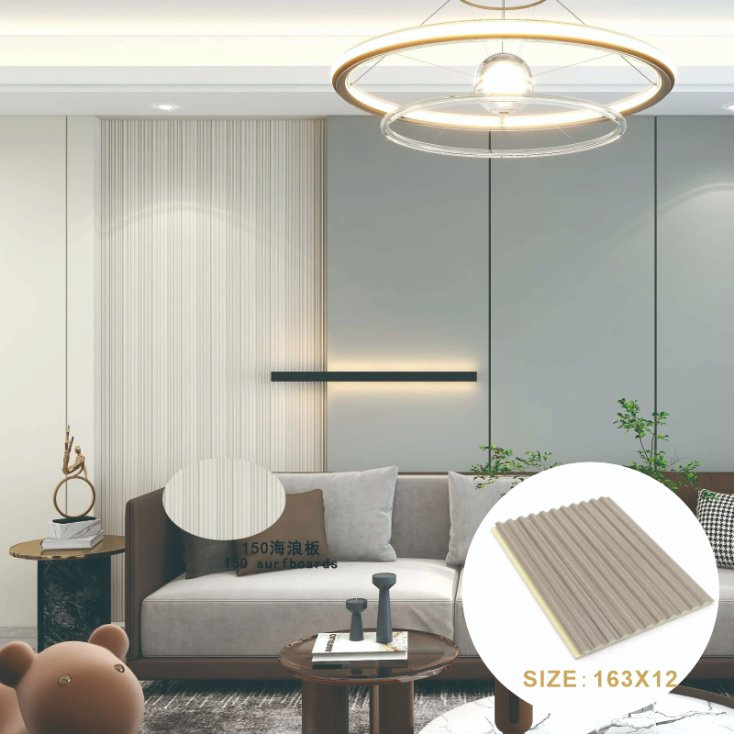
The SD-AGWP024 takes its name — 海浪板, surfboard panel — from the profile that defines it: a series of smooth, continuous wave-form ribs that undulate across the panel face like a cross-section of a calm sea. Where square-profile batten panels create hard-edged architectural geometry, the SD-AGWP024's wave ribs are entirely curved — convex crowns rolling smoothly into concave valleys, the surface never breaking into a flat plane or a sharp angle. Installed vertically across a wall surface in continuous runs, the wave profile generates a living, shifting light effect that changes character entirely across the day: soft and tonal under ambient light, dramatically shadowed under directional downlighting, luminous and diffused behind a concealed LED strip. The 150mm panel width creates a medium-pitch wave rhythm — wide enough to read as individual surface elements from across a room, tight enough to produce a richly textured wall surface rather than an isolated architectural feature.
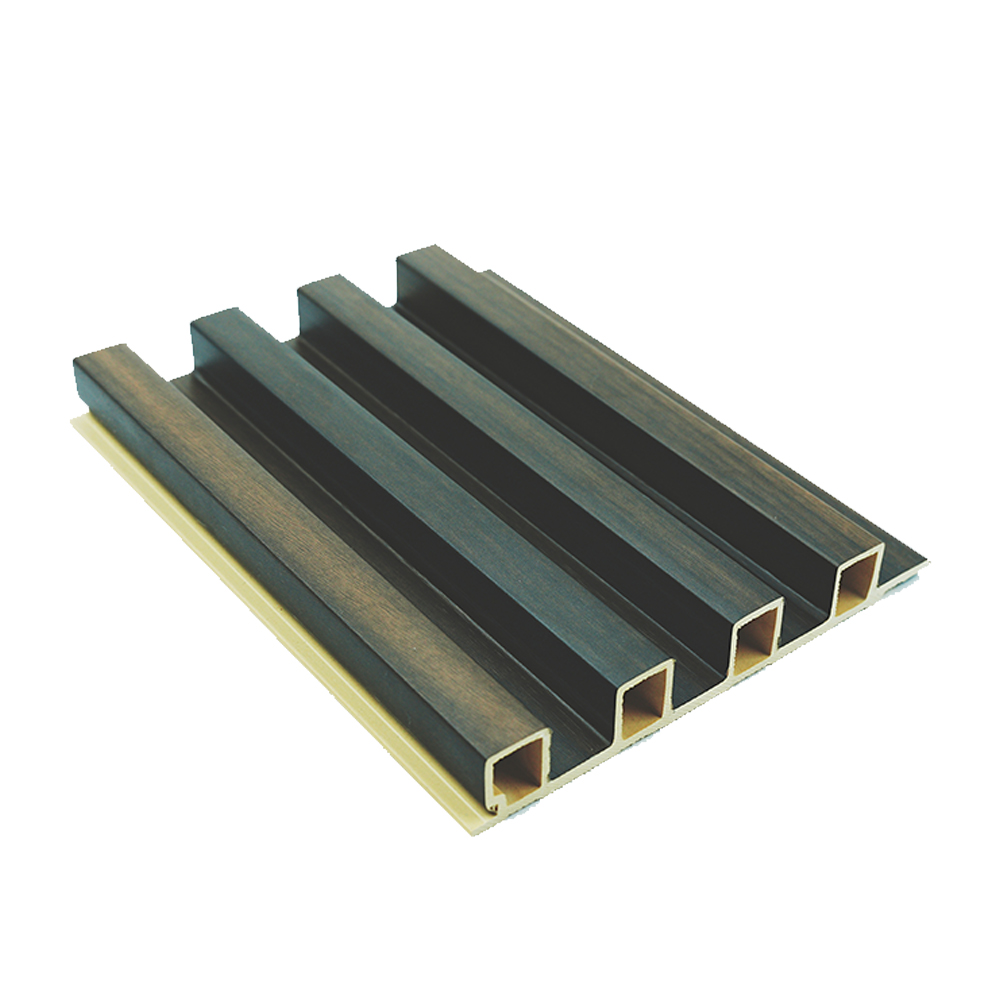
This image shows what the SD-AGWP028 is at its most fundamental level — a precision-extruded WPC panel of four square hollow tubes, standing upright from a flat base plate, with deep open channels between each batten that reach all the way to the base. The cross-section view removes all ambiguity: each batten is a true square hollow profile with flat top, perfectly vertical sides, and sharp 90° corners throughout — the geometry is as clean and resolved as an architectural detail drawing. The dark wenge woodgrain finish covers every surface of every batten continuously — top face, all four side faces, and the channel floor between ribs — so the installed wall reads as a unified dark-timber surface regardless of viewing angle or lighting direction.
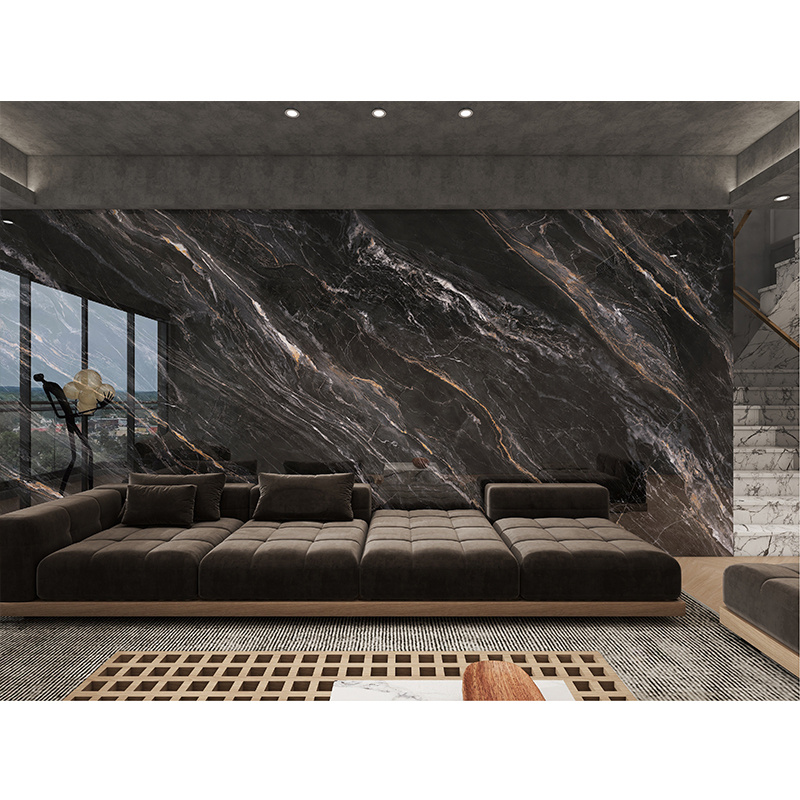
There is a specific register of luxury that only dark materials can occupy — the gravity, the drama, the sense that a room has mass and intention. The SD-AGWP034 in Black Gold Vein delivers that register as a full living room feature wall: deep black ground, broad diagonal white crystalline veins sweeping from corner to corner like frozen continental movement, rose-gold accent veins tracing finer lines through the darkness. Under the recessed downlights visible in this render, the high-gloss black surface catches each light source as a sharp specular highlight — so the wall is simultaneously the darkest and the most luminous surface in the room, a paradox that only polished dark stone (or a very good panel system that mimics it) can achieve. The white marble staircase on the right and the raw concrete ceiling above do not compete with this wall — they frame it, setting the black marble as the centrepiece of an interior that understands material contrast as a design language.
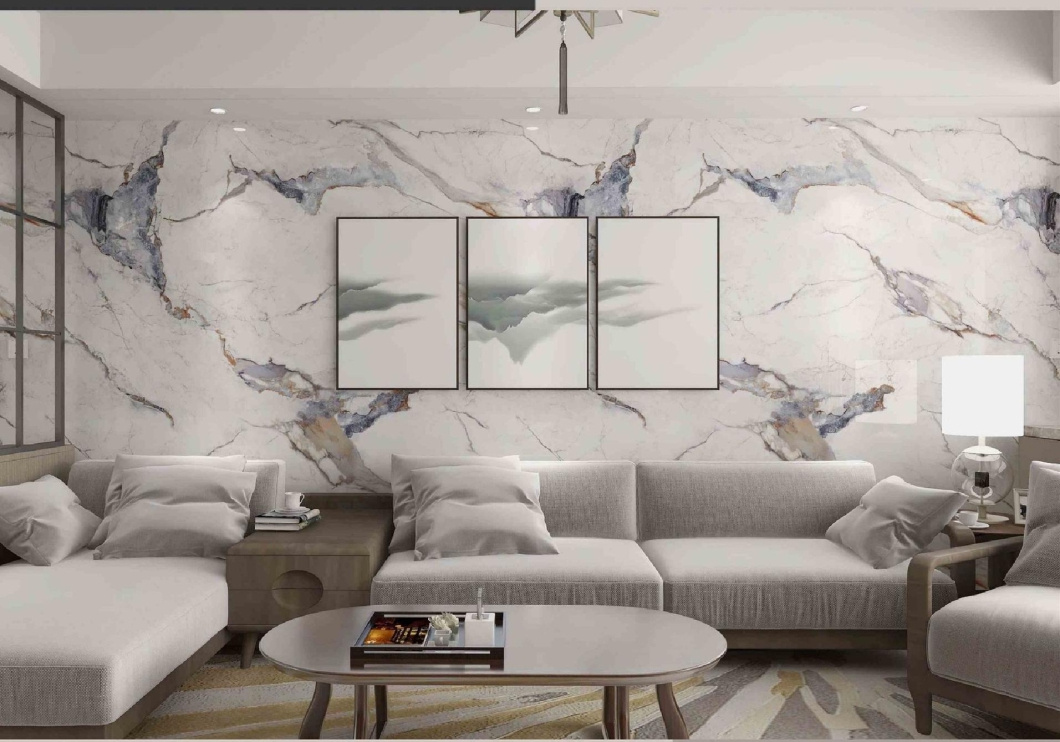
There is a moment in Chinese ink painting where the ink spreads into wet paper and pools in formations that no brush could have planned — dark clouds gathering, mountain shadows dissolving into mist. The SD-AGWP034 Calacatta Viola colourway reproduces that moment in stone: slate-blue mineral formations pooling across a white crystalline ground, amber-gold veins tracing their paths through the blue like rivers through mountain terrain, fine grey fracture lines mapping the geological stress of a surface that looks as much painted as quarried. Hung with three Chinese ink wash landscape paintings — clouds, mist, distance — this living room wall is making an explicit conversation between the stone on the wall and the art on the stone: both are depictions of the same natural world, one rendered in pigment, one grown in the earth over a million years. The SD-AGWP034 Calacatta Viola is the correct panel for an interior that understands this conversation.