
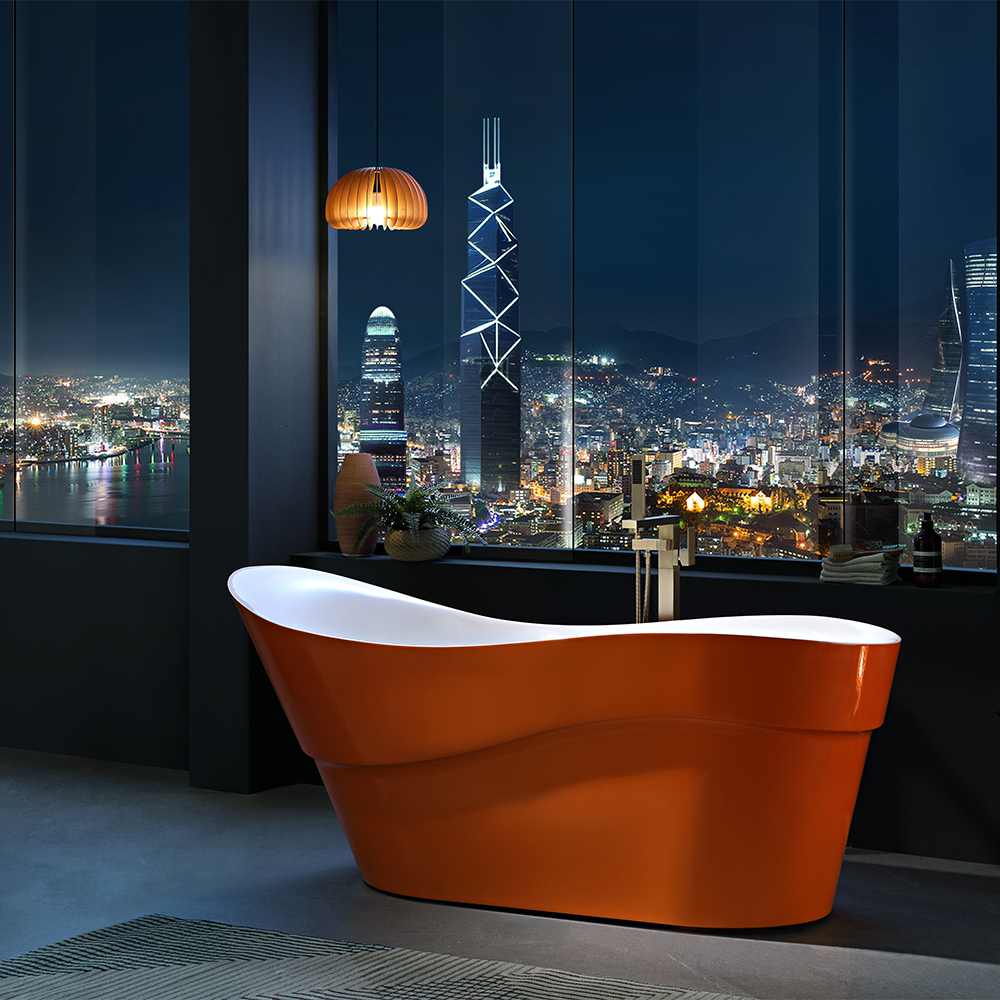
It announces itself the moment you enter the room. The SHUIDAO burnt orange metallic oval slipper freestanding bathtub is the boldest colour statement in the SHUIDAO range — a deep, warm copper-orange metallic exterior with a fine brushed directional finish that shifts from amber to bronze as the light moves across it. Against the white interior basin and the dark grey floor, the orange reads with the confidence of a collector's piece: rare, deliberate, and completely irreplaceable in the spaces it occupies.
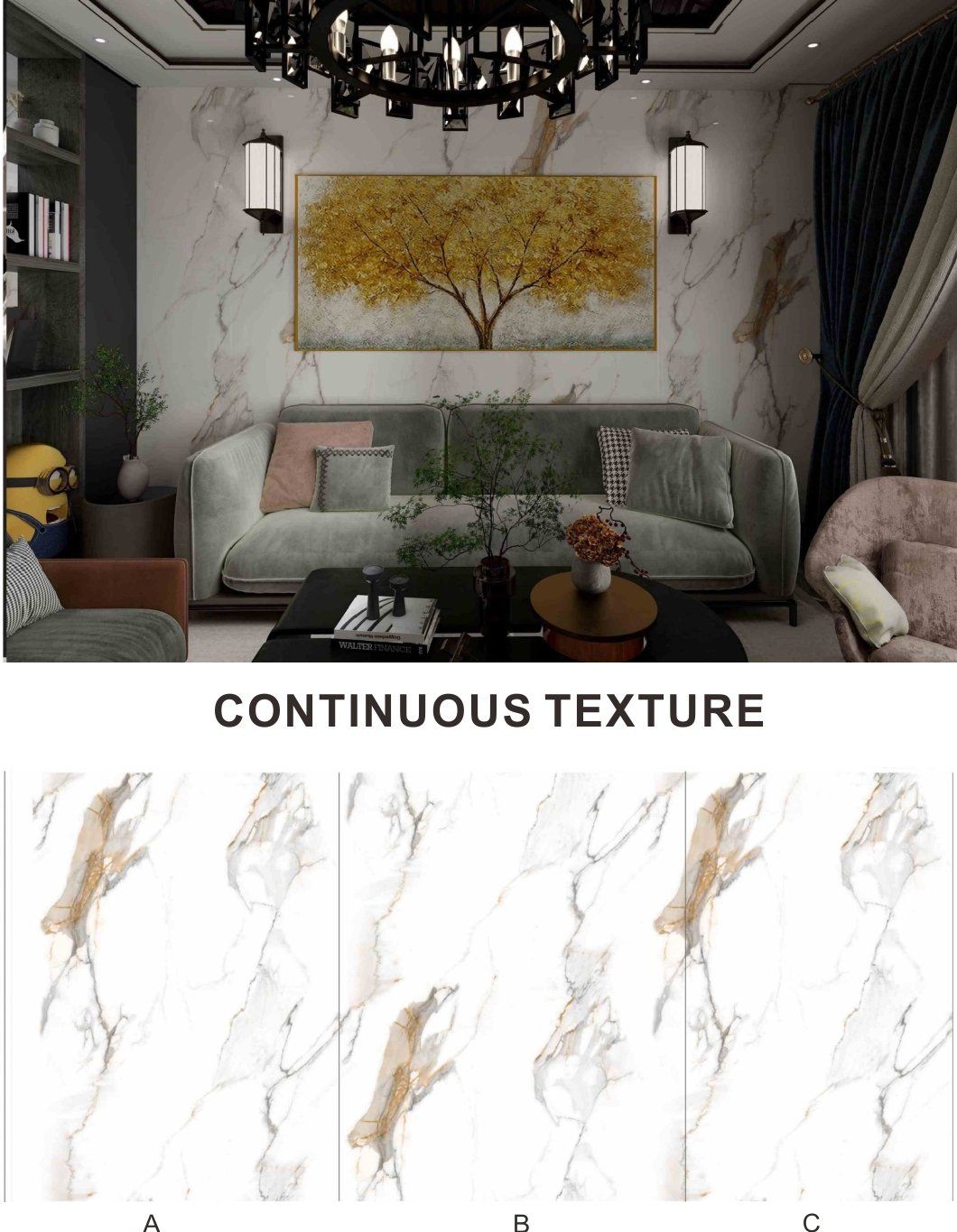
The gold painting and the gold wall are in conversation. The artist who hung a golden tree oil painting on a Calacatta Gold marble wall understood something precise: that the amber-honey veins flowing through the marble are the same colour as autumn leaves, as raw gold, as the warm light of a late afternoon — and that a wall which already contains that colour makes every object placed in front of it resonate at the same frequency. The SD-AGWP034 Calacatta Gold colourway works this way in a room: the gold veins in the marble are not decoration on a background, they are a ground tone that tunes the entire room's colour register. The sage green sofa, the gold painting frame, the amber flower arrangement, the copper coffee table accessories — all of these warm tones find their anchor in the marble wall's gold vein formations, pulled into coherence by a material that contains all of them simultaneously.
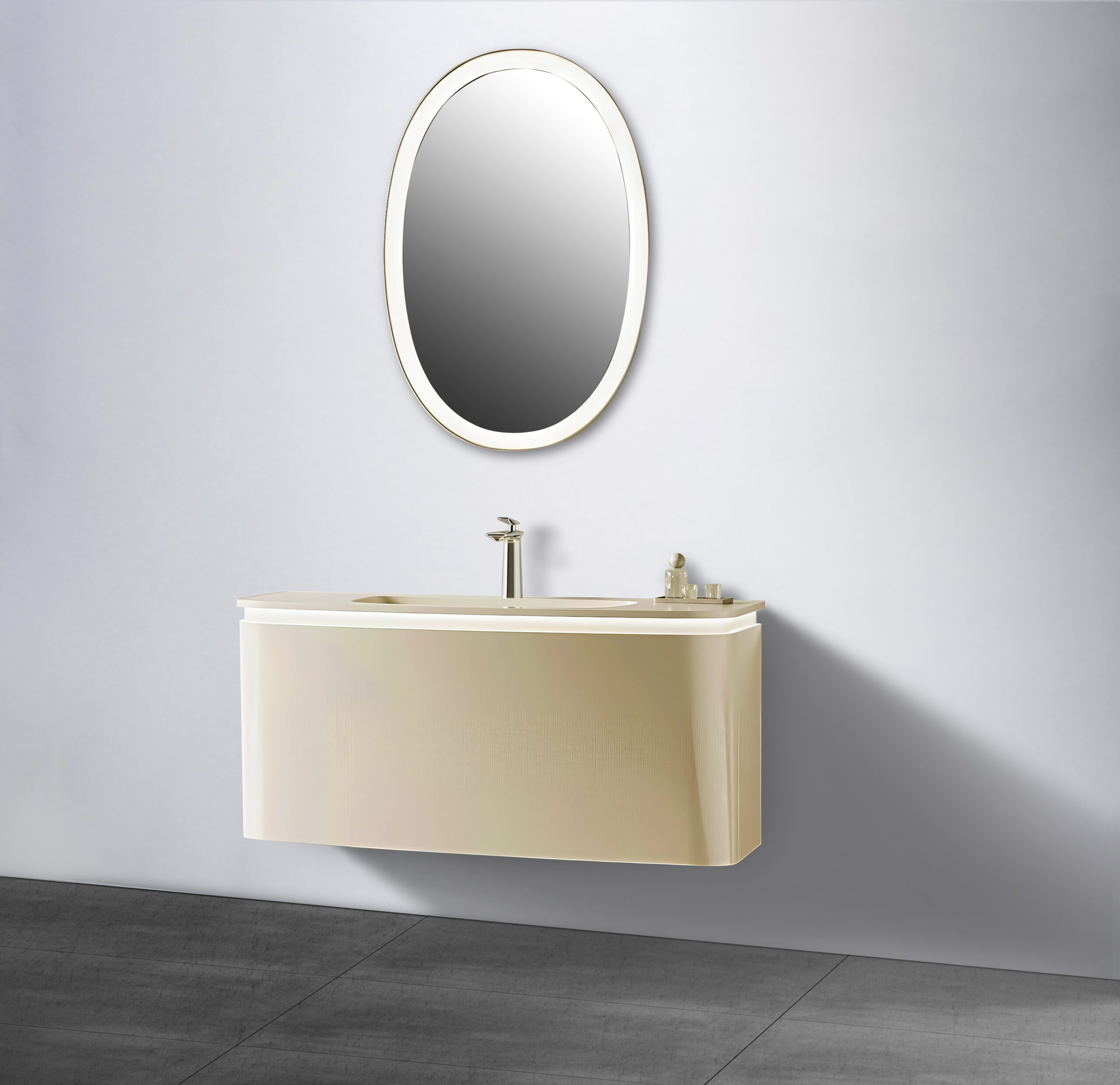
Light from below, light from above, and gold between them. The BC008 is the most luminous piece in the bathroom cabinet range — a wall-hung cabinet finished in a warm champagne gold high-gloss lacquer that shifts between pale gold, rose champagne, and warm cream as the viewing angle and ambient light change. A thin white LED strip runs the full width of the top edge between the cabinet body and the integrated countertop, casting a soft warm glow downward across the reflective cabinet face. The overall effect is of a cabinet that appears to emit light rather than merely reflect it. Above, an oval LED backlit mirror with a wide white surround frame completes the composition — the white mirror border and the white LED edge of the cabinet echoing each other across the wall. This is a vanity suite for rooms that begin with light and end with gold.
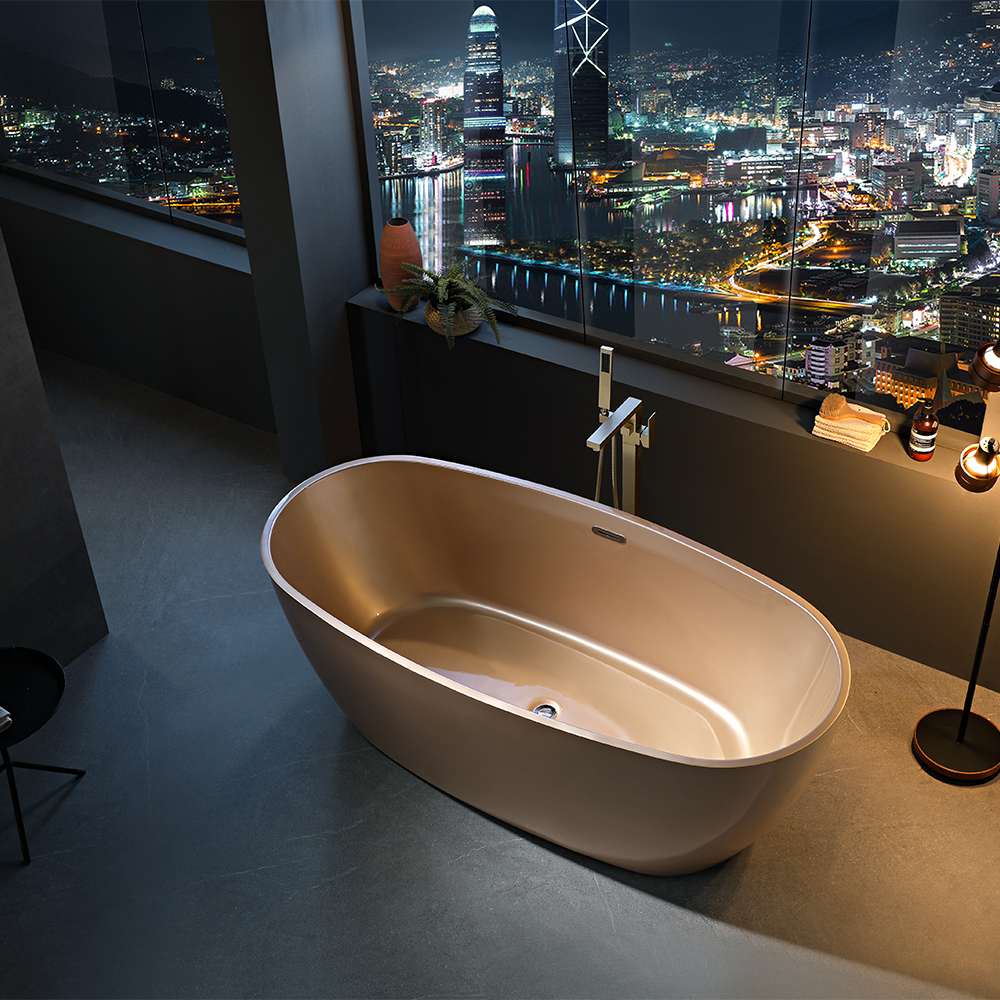
Gold, but make it quiet. The SHUIDAO champagne gold oval freestanding bathtub is the most distinctive colour statement in the SHUIDAO range — a warm, matte champagne-rose gold finish that catches the light differently at every hour of the day and transforms completely under the glow of a city at night. This is not a white tub in a gold room. This is a gold tub that makes the room. Paired with a slim brushed nickel square floor-mount filler, the warm-cool metallic contrast is precise, intentional, and completely resolved.
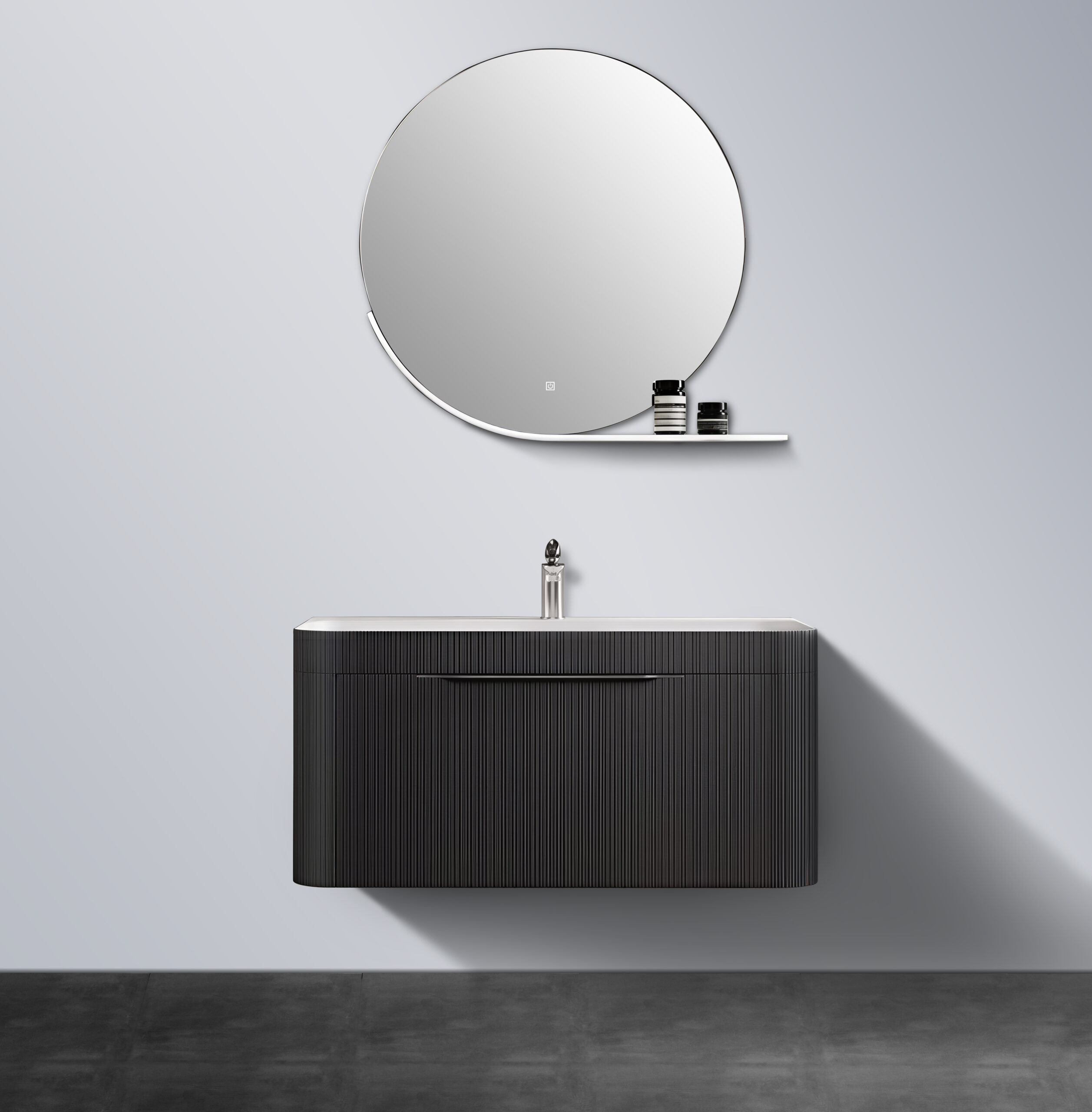
Dark, soft, and completely unified. The BC006 presents the vertical fluting surface language in deep charcoal grey — a tone that is neither the matte black of the BC005 nor the natural oak of the BC07x family, but a warm dark grey that sits between them; cool enough to feel sophisticated, warm enough to feel inviting. The most distinctive formal feature of BC006 is its exceptionally generous rounded corners — the cabinet body curves at both left and right sides with a radius significantly larger than any other rounded-corner member of the family, giving the floating cabinet a soft, almost pillow-like silhouette that reads as more sculptural and organic than architectural. The white integrated basin top flows seamlessly from the curved sides down through the flat face below without visible transition. Above, a circular LED mirror is paired with an integrated flat shelf that extends beyond the mirror's lower perimeter as a convenient, accessible accessory surface.
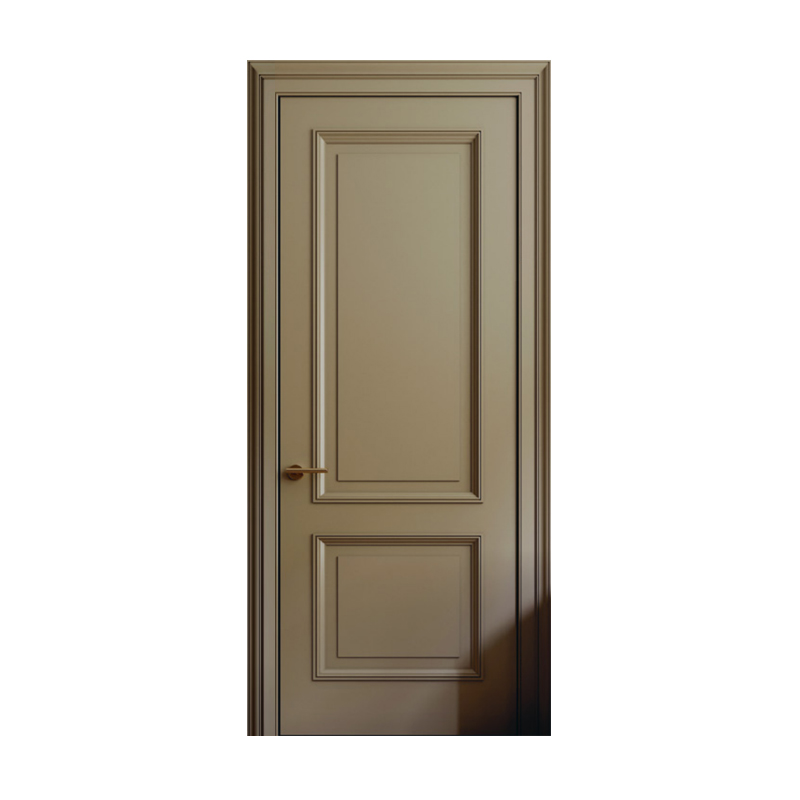
The D8648 and D8646 share the same two-panel classical DNA, but the D8648 deepens the proposition — where the D8646's warm putty finish reads as light and airy, the D8648's olive-taupe ground is richer, more saturated, more anchored. It is the colour of aged plaster in a southern European villa, of Roman stone warmed by afternoon light, of interiors that feel both old and entirely current. The gold shadow-line moulding — the same fine accent detail that defines the D8646 — traces every panel edge and architrave profile here with particular luminosity against the darker ground, the warm gold reading more emphatically against the olive base than it would against a lighter tone. The brushed brass lever handle completes the tonal programme: three materials, one warm register, zero visual conflict.
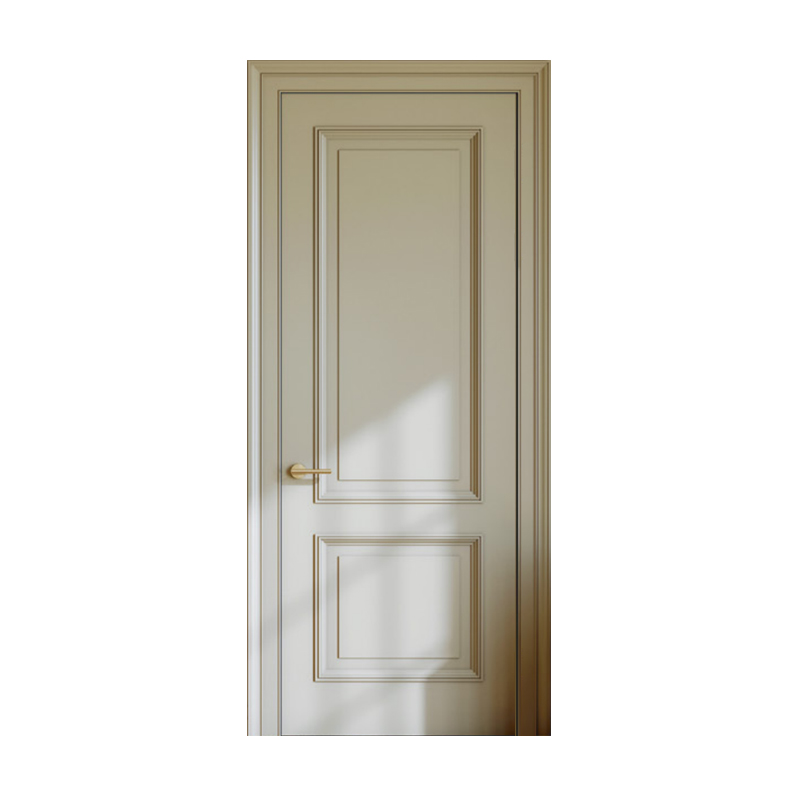
Where the D8645 delivers the formal authority of three panels, the D8646 arrives at something more intimate — a two-panel composition with a tall upper panel and a wider lower panel, their proportions settled and unhurried, the moulding framing each panel rendered in a warm gold shadow-line that traces every edge with quiet precision. The finish is a sophisticated warm grey-green — neither sage nor stone, but the particular off-neutral tone that has become the signature of refined contemporary classical interiors — and the brushed brass lever handle reads as an intentional material continuation of the gold moulding line, the two working together as a considered tonal pair. Natural light falls across the door surface in the image, confirming the low-sheen quality of the finish and the delicate dimensionality of the raised panel relief.
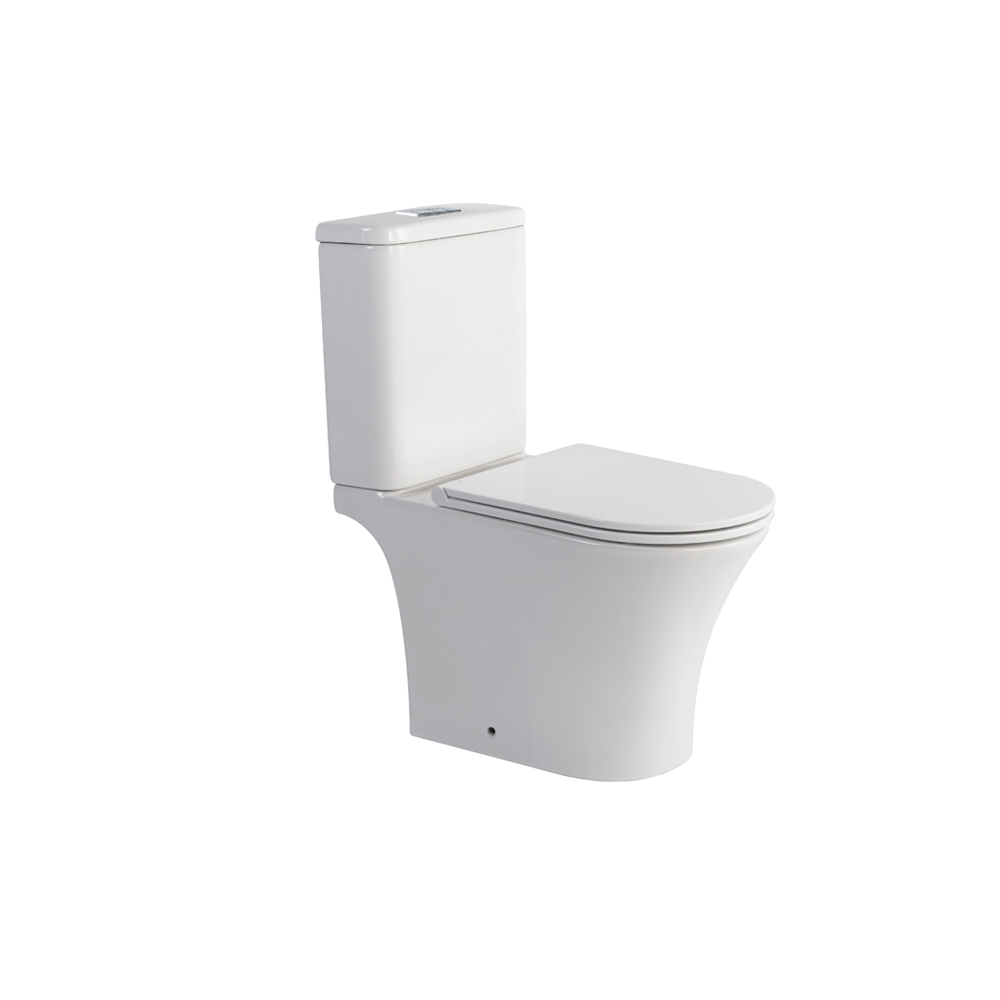
The CT-004 introduces the most distinctive silhouette in the CT series — a pan body that flares outward from a narrow waist at the cistern join and sweeps dramatically wide at the floor, like the bell of a trumpet caught mid-breath. It is a toilet that owns the floor space it occupies, projecting quiet confidence rather than shrinking into the background. The cistern sits closer to standard height here, its proportions more balanced, making the entire unit feel grounded and complete.
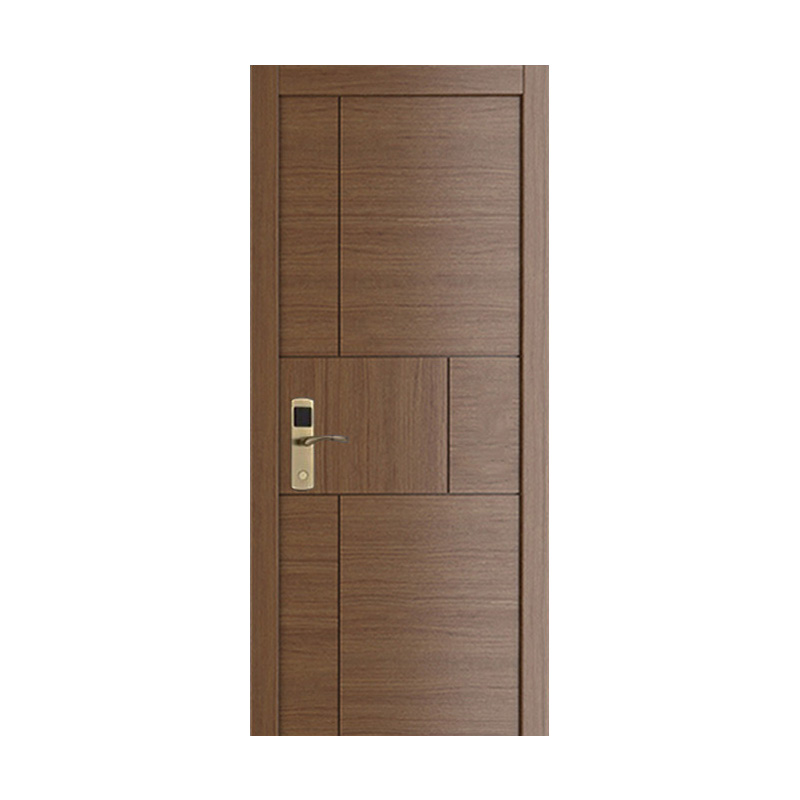
The D8660 introduces the most architecturally considered surface composition in the SHUIDAO smart lock door range. Rather than a plain flush face or evenly spaced horizontal grooves, the D8660 maps the door surface as a grid of woodgrain panels — a composition that borrows its logic from stone cladding, large-format tile layouts, and contemporary facade design. The upper half of the door is divided into a symmetrical two-column grid of four equal rectangular panels; the lower half shifts to an asymmetric three-panel layout — two narrower side panels flanking a wider central panel — before resolving into a full-width base section. The vertical and horizontal seam lines between panels are routed or inlaid as precise dark hairlines, the grid reading as a deliberate graphic over the continuous mid-tone walnut woodgrain. The gold electronic lever lock, positioned at the left stile at the grid's horizontal mid-line, sits exactly at the visual hinge point between the upper symmetrical and lower asymmetrical zones — a placement that feels considered rather than incidental.
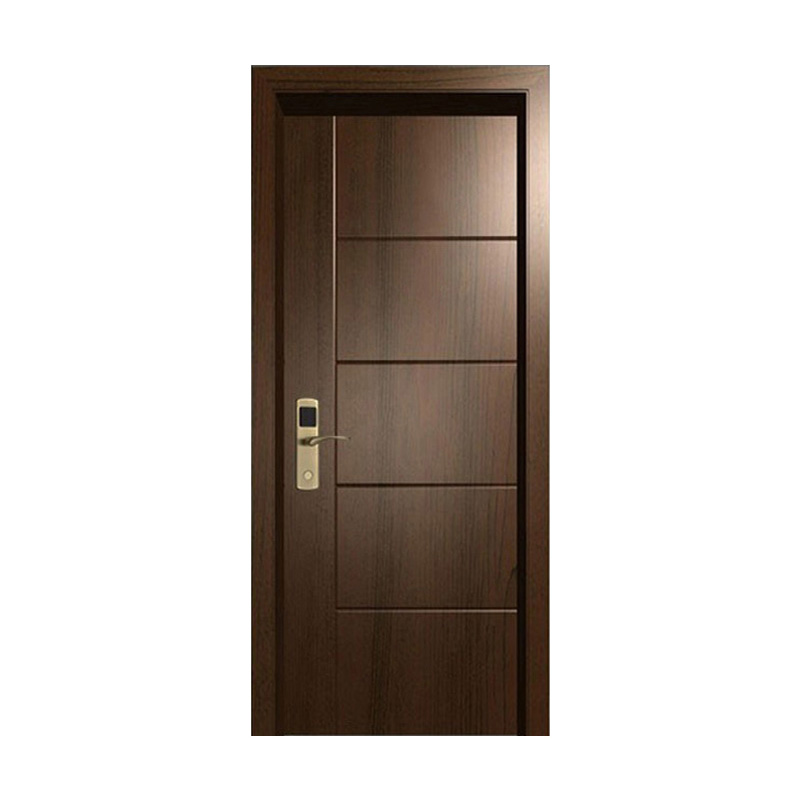
If the D8657 is the pure minimalist position — flush, uninterrupted, silent — the D8658 is its warmer, more textured counterpart. The same hotel-grade smart lock format, the same gold electronic lever escutcheon, the same contemporary hospitality brief; but the door face here is articulated by a series of horizontal routed grooves that divide the flush woodgrain surface into five equal-height bands. The grooves are shallow and precise — dark recessed lines cut across the full width of the door face, running parallel and evenly spaced from top to bottom. Against the warm walnut-brown woodgrain, these horizontal lines do exactly what good surface design does: they add rhythm without complexity, depth without decoration, and a sense of crafted intention to what would otherwise be a plain flush face. The colour shift from the D8657's near-black wenge to this warm mid-walnut brown also changes the door's register entirely — the D8658 is inviting where the D8657 is austere, residential where the D8657 is commercial.
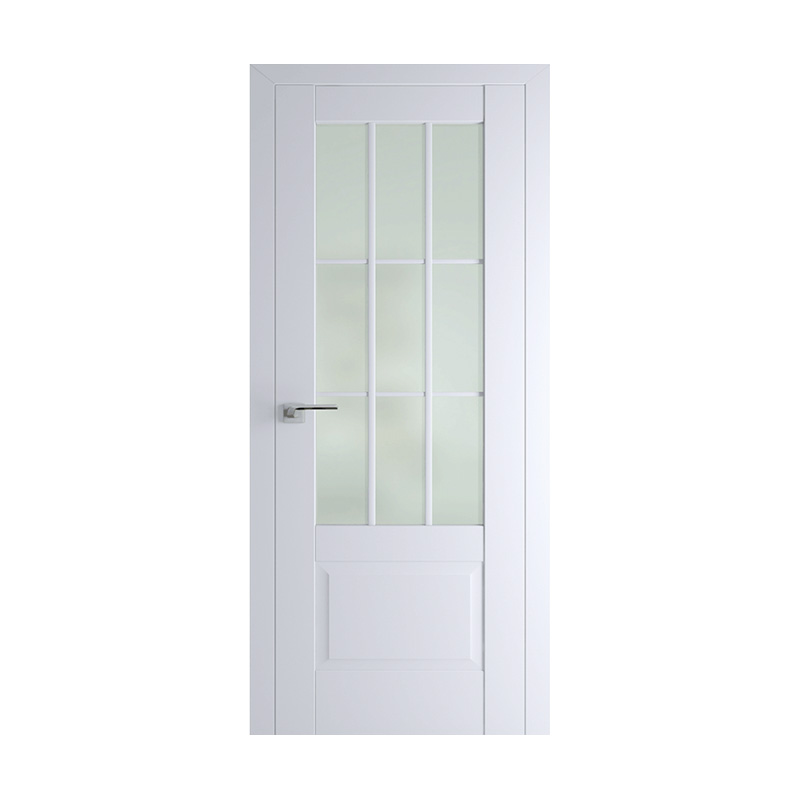
The D8703 completes the white glazed door quartet alongside the D8700, D8701, and D8705 — and its position within the set is precisely defined. It is the white-finish counterpart to the D8704's black nine-pane grid, and the fully specified companion to the D8701's six-pane partial-glaze format. The glazed section here is a 3-column × 3-row nine-pane grid — three columns, three rows, nine near-square frosted glass panes — occupying the upper two-thirds of the door face, with a single solid raised panel closing the lower third. If the D8700 is the French casement (tall, two-column, fully glazed), the D8701 is the Georgian partial glaze (two-column, solid lower panel), and the D8705 is the minimalist single pane, then the D8703 is the Shaker — the door format that has dominated contemporary residential interior design globally for the past two decades precisely because it sits at the exact intersection of classical precedent and modern restraint. The 3×3 nine-pane grid in white reads simultaneously as traditional and contemporary: traditional because the grid-and-panel composition has roots in 18th-century joinery; contemporary because in white, with slim glazing bars and a brushed chrome bar handle, it belongs entirely to the present.
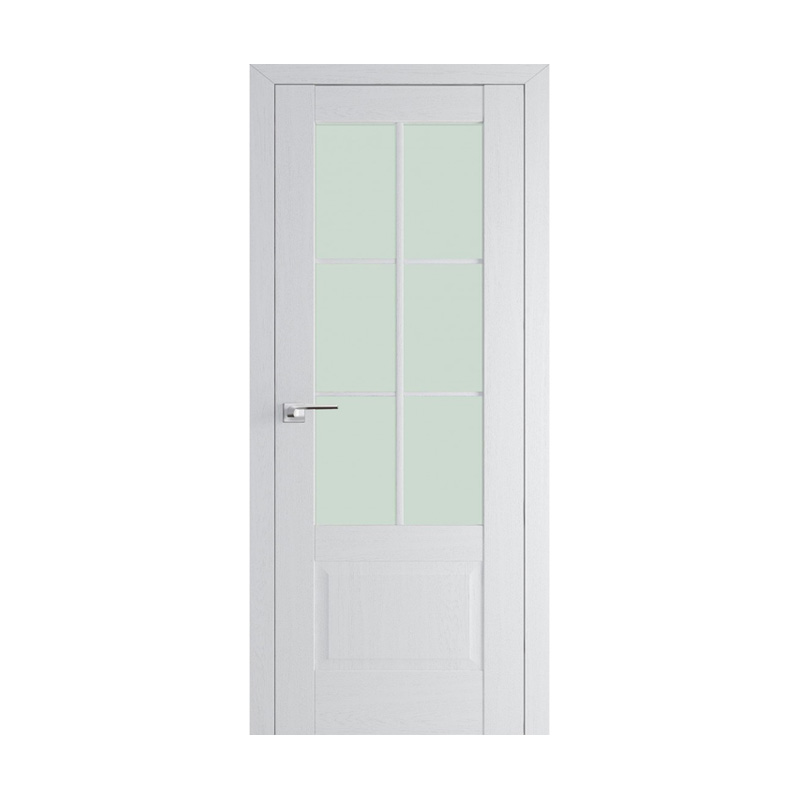
The D8701 is the direct companion to the D8700 — same white finish, same brushed chrome bar handle, same 2-column grid glazing format — but with one structural decision that changes the door's entire character and application range: the return of a solid lower panel. Where the D8700 is fully glazed from top rail to bottom rail, the D8701 dedicates its lower third to a single solid raised panel in matte white, leaving only the upper two-thirds of the door face glazed. The glazed grid consequently compresses from eight panes to six — two columns of three rows — and the panes, now accommodated in a shorter overall glazed height, become slightly more square in proportion than the tall, vertical panes of the D8700. This is not a lesser door than the D8700; it is a differently specifiable one. The solid lower panel restores the structural solidity, acoustic contribution, and everyday practicality that a fully glazed door sacrifices — resistance to kick damage, reduced light leakage at floor level, better sound attenuation in the lower register — making the D8701 the more appropriate specification wherever a fully glazed door would be acoustically, structurally, or practically compromised.
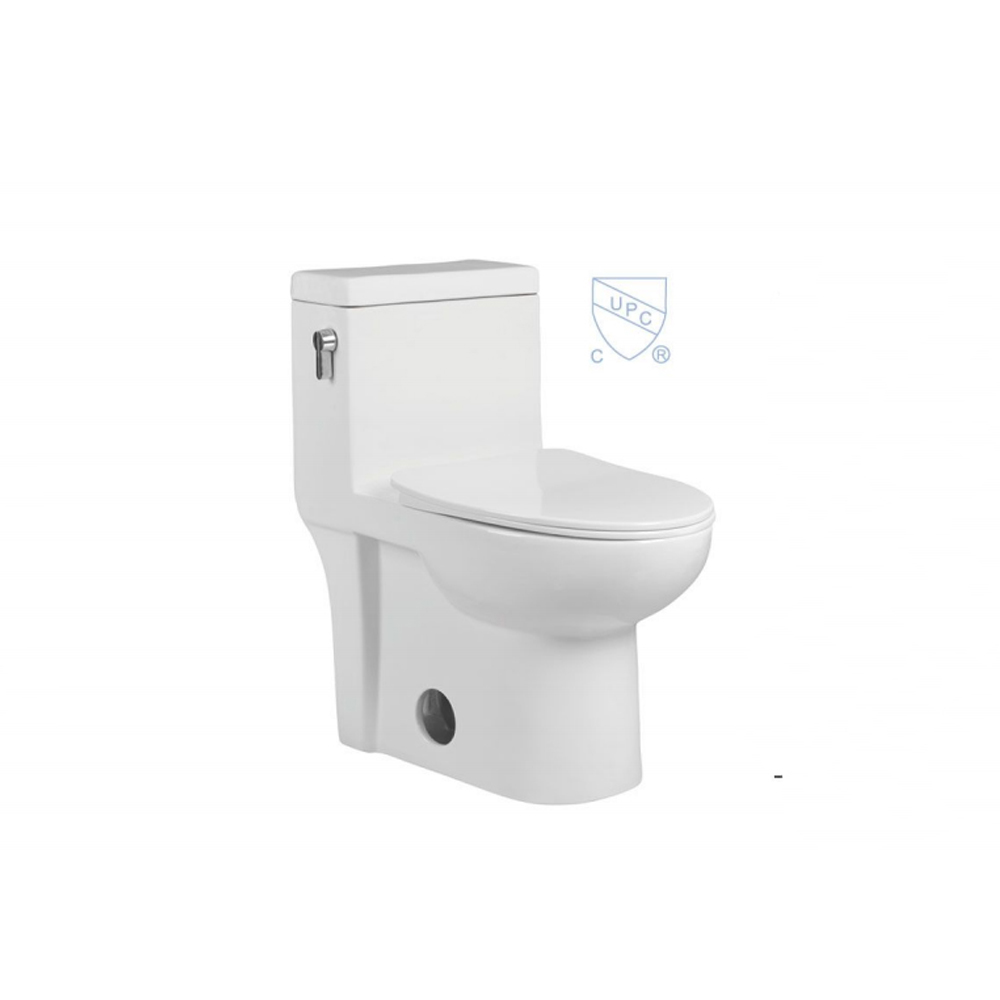
The CT-008 occupies the pragmatic centre of the one-piece range — neither the smooth contemporary sweep of the CT-006 nor the ornate classical relief of the CT-007, but a clean, no-excess form that simply does everything right. The cistern is compact and flat-topped, the skirted pan body is gently rounded without theatrical gesture, and the whole unit presents an honest, resolved silhouette that will harmonise with virtually any bathroom scheme without demanding attention. A dark circular cap is visible at the front base — likely a floor bolt access cover — adding a subtle graphic detail at ground level. cUPC certified for the North American market.
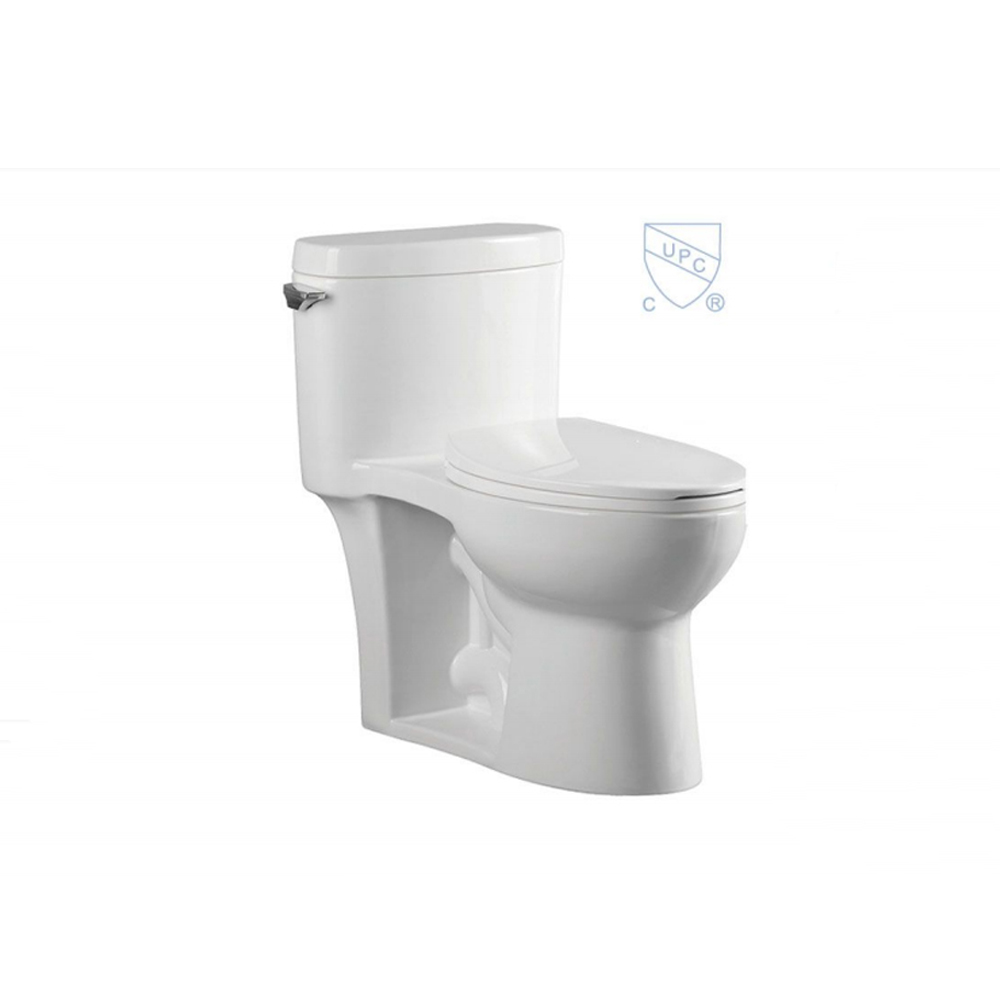
A departure from the two-piece close-coupled forms of the CT series, the CT-006 is a true one-piece toilet — cistern and pan cast and fired as a single, seamless ceramic body. The profile is classically American in proportion: a tall, gently curved cistern flowing without interruption into a fully skirted elongated pan, the whole unit anchored to the floor on a broad, stable base. The chrome side-lever flush handle signals its intended market immediately — this is the CT series' North American export specification, confirmed by the cUPC certification mark visible in the image
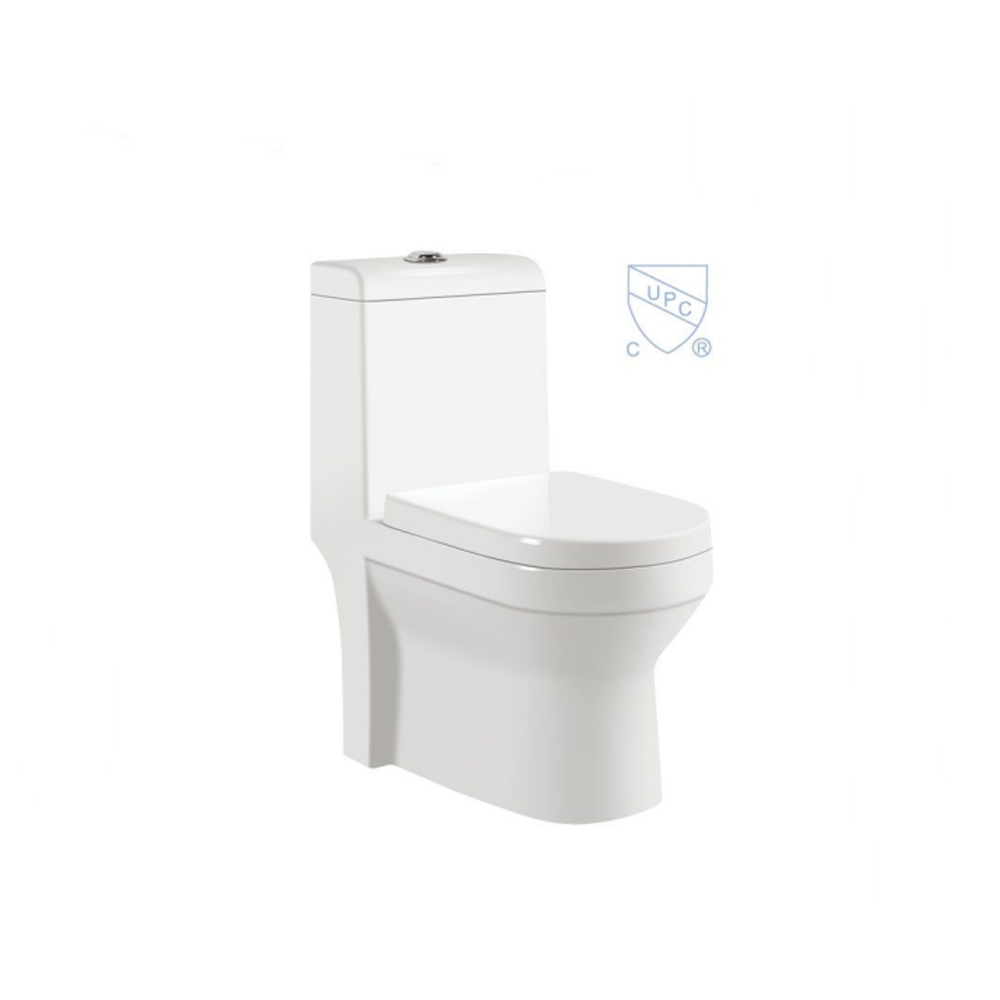
The CT-010 is the most architecturally resolved toilet in the CT series — a full commitment to the rectangle from lid to floor, with barely a concession to organic curvature anywhere along its body. The cistern and pan share the same vertical plane on the rear face, creating a single unbroken flat back wall. The sides taper with the gentlest of angles toward the front, and only at the very base do soft rounded corners acknowledge the floor. It is a toilet designed for the bathroom that takes its geometry seriously — where square-edge tiles, flat-front cabinetry, and rectilinear basins demand an equally disciplined sanitary ware specification. The top-flush button replaces the side lever entirely, maintaining the unbroken surface of every visible face. cUPC certified for the North American market.
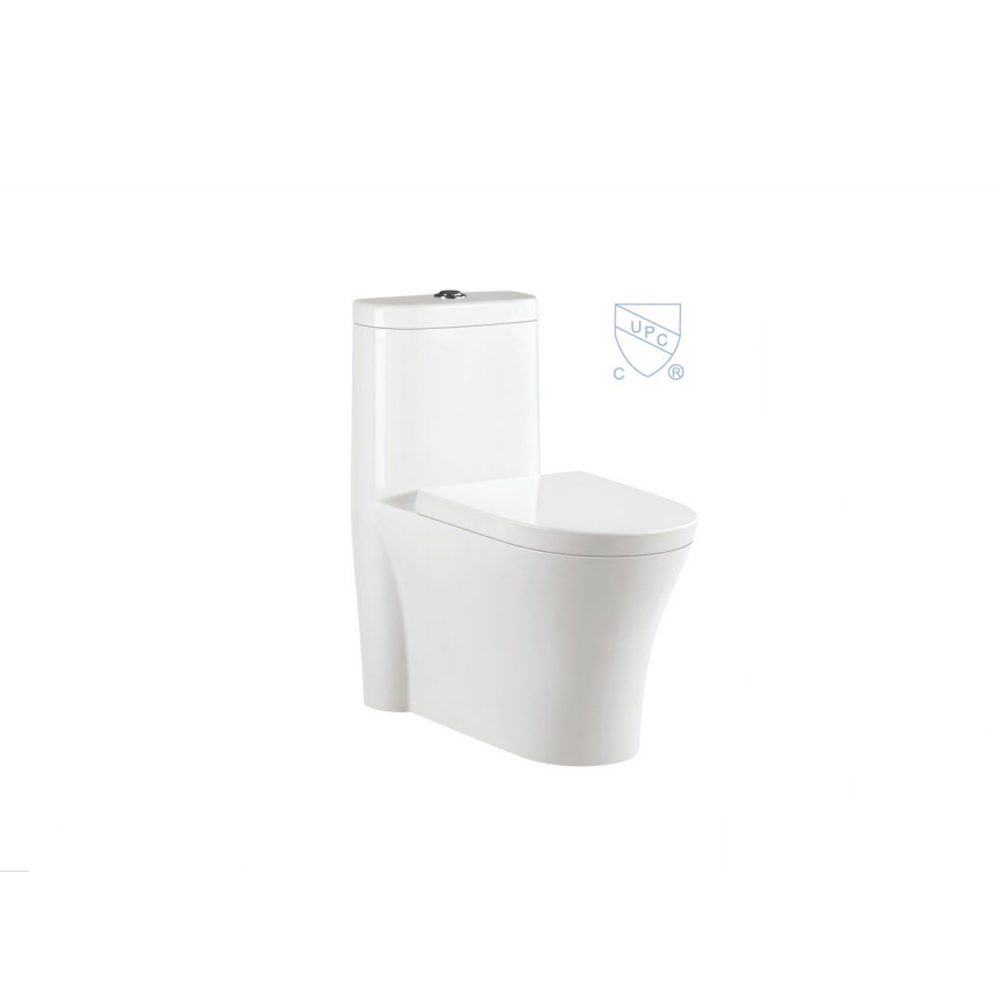
The CT-012 takes the proportional drama of the CT-011 and introduces a new formal move — a defined waist. Where the CT-011 transitions directly from its tall slim cistern into a broadly swelling pan, the CT-012 narrows deliberately at the mid-body before flaring back out into an expansive oval base that extends generously in all directions. The effect is of a form that gathers itself before opening up — the pan silhouette reading almost like a tulip or a wine glass in profile, with genuine sculptural intentionality. The chrome top-flush button sits neatly centred on the flat cistern lid, and cUPC certification confirms this unit's North American market readiness.